
Chinese Communist Party (CCP) leader Xi Jinping recently delivered a speech to commemorate the 90th anniversary of communist troops’ “Long March,” and analysts say he is attempting to consolidate power ahead of the upcoming top political meeting amid fierce infighting within the Party.
At the speech, held in the Great Hall of the People in Beijing on Oct. 22, Xi said that the CCP once reached a “critical juncture of life-or-death survival” and credited Mao Zedong with saving both the Party and the Red Army—the CCP’s troops.
Xi further called for upholding “the centralized and unified leadership of the Party,” maintaining the CCP’s absolute leadership over the military, and remaining “prepared at all times to withstand major tests—from high winds and rough seas to even the most turbulent, stormy waters.”
The CCP’s Red Army was an anti-government and insurgent guerrilla force during the Republic of China and was forced to abandon its base in Jiangxi Province in southeast China during the Nationalist government’s fifth elimination campaign from 1934 and 1936 to escape to Shaanxi Province in northwest China. The CCP portrays this desperate flight as the “Long March”—a victory and a strategic choice to go north to fight against invasion by the Japanese. However, as historical records show, the main battlegrounds for the war against Japan were along the coast in the East and South, where Nationalist troops were the main force that fought the long and hard war against Japan.
The Red Army started with more than 80,000 people at the beginning of the “Long March,” and only about 7,000 to 8,000 remained upon their arrival in northern Shaanxi. It was during this period that Mao Zedong rose to the top leadership position of the CCP.
Shortened Speech
Compared to his speech commemorating the 80th anniversary of the Long March a decade ago, Xi’s speech this year was one-third of the length and contained about the same proportion dedicated to “strengthening the military.”
Ten years ago, Xi had just completed his military reforms and appointed new leadership. However, in recent years, many top military officials, including those Xi appointed, have been purged during the CCP’s infighting—including by Xi himself.
Xi’s emphasis now on strengthening the Party’s absolute leadership over the military is, in reality, an attempt to justify his ongoing purges of the military’s top brass and the consolidation of his own personal, autocratic rule, Feng Chongyi, a China studies professor at the University of Technology Sydney, told The Epoch Times.
“Xi Jinping has alienated too many people. Officials despise him and want him removed from power,” Feng said.
“Currently, the most pressing issue for Xi Jinping concerns power struggles within the Party and the military,” Feng added. “He is particularly keen to emphasize how Mao Zedong, at a critical juncture, saved both the Party and the Red Army—drawing a parallel to his own efforts to ‘save’ the Party amidst what he describes as ‘high winds and rough waves.’ Through such commemorations, he seeks to elevate his own stature.”

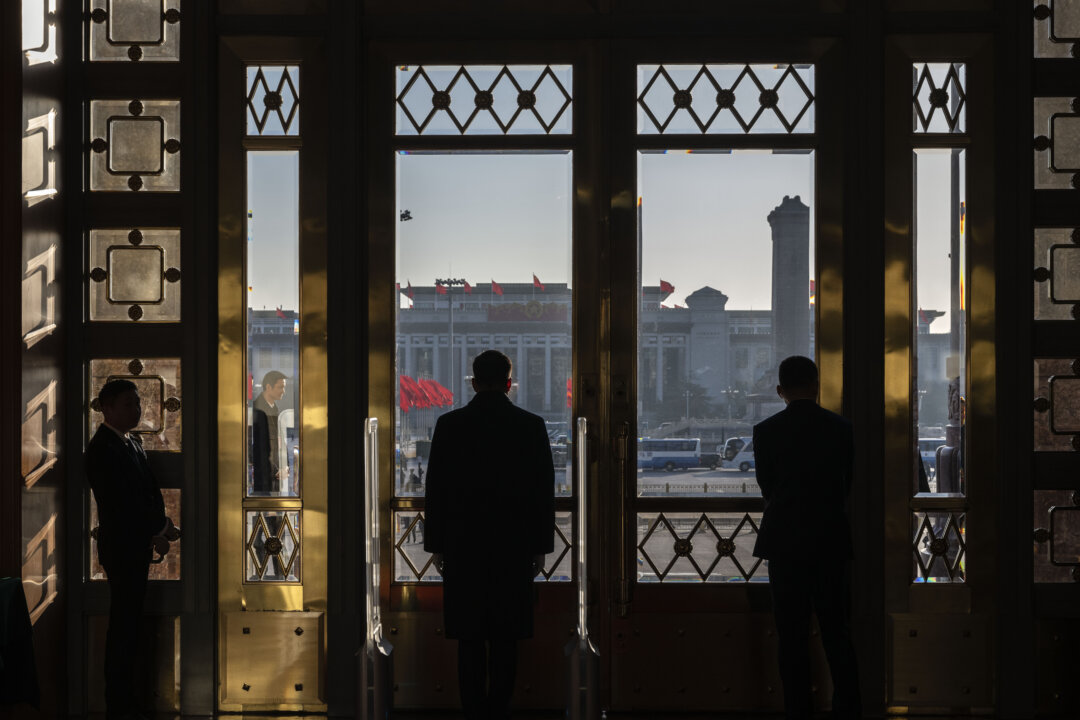
Military delegates attending the Chinese Communist Party’s National People’s Congress undergo security checks as they enter the Great Hall of the People in Beijing on March 5, 2026. Kevin Frayer/Getty Images
The current situation that the Chinese regime is facing both domestically and internationally—described in Xi’s speech as a profound transformation unseen in a century—is being likened to the “Long March.” This, in itself, amounts to an admission that Xi is currently facing a major political crisis, Tang Jingyuan, a U.S.-based China analyst and current affairs commentator, told The Epoch Times.
Xi’s speech was delivered prior to the Fifth Plenary Session of the CCP, which will be held from Oct. 26 to 29.
“The Fifth Plenary Session will effectively determine whether Xi Jinping can secure another term at the 21st National Congress next year,” Tang said.
Xi’s speech to commemorate the 90th anniversary of the “Long March” was not broadcast live, departing from established practice, with many high-ranking military officials absent.
U.S.-based China analyst Li Linyi told The Epoch Times that when viewed alongside the unusual circumstances surrounding Xi’s recent overseas visits, the lack of a full broadcast—coupled with the fact that Xi’s speech was significantly shorter than the one he delivered 10 years ago—raises questions about whether he might be experiencing health issues, prompting officials to deliberately avoid scheduling a lengthy address from him.
During Xi’s visit to the United States in September, concerns were raised regarding his health. Several U.S. media outlets reported that Xi required a private lounge to be provided by the White House, and he appeared to need his wife, Peng Liyuan, to assist him whenever he navigated stairs. Furthermore, Xi was absent from a luncheon hosted by the U.S. president; notably, he had also been conspicuously absent from a state banquet during his visit to India weeks earlier.
Tang Bing and Luo Ya contributed to this report.







 English (US) ·
 Turkish (TR) ·
