
PARIS—Clashes broke out at the end of protest marches in Paris, Marseille, and a dozen other French cities on Saturday, with police making nearly 1,000 arrests, but the looting and destruction that marked the previous weekend were largely contained after the government deployed 70,000 police officers and gendarmes.
In Paris, masked individuals pelted police with projectiles and fireworks near the end point of the march, and officers responded with tear gas, stun grenades, and water cannons.
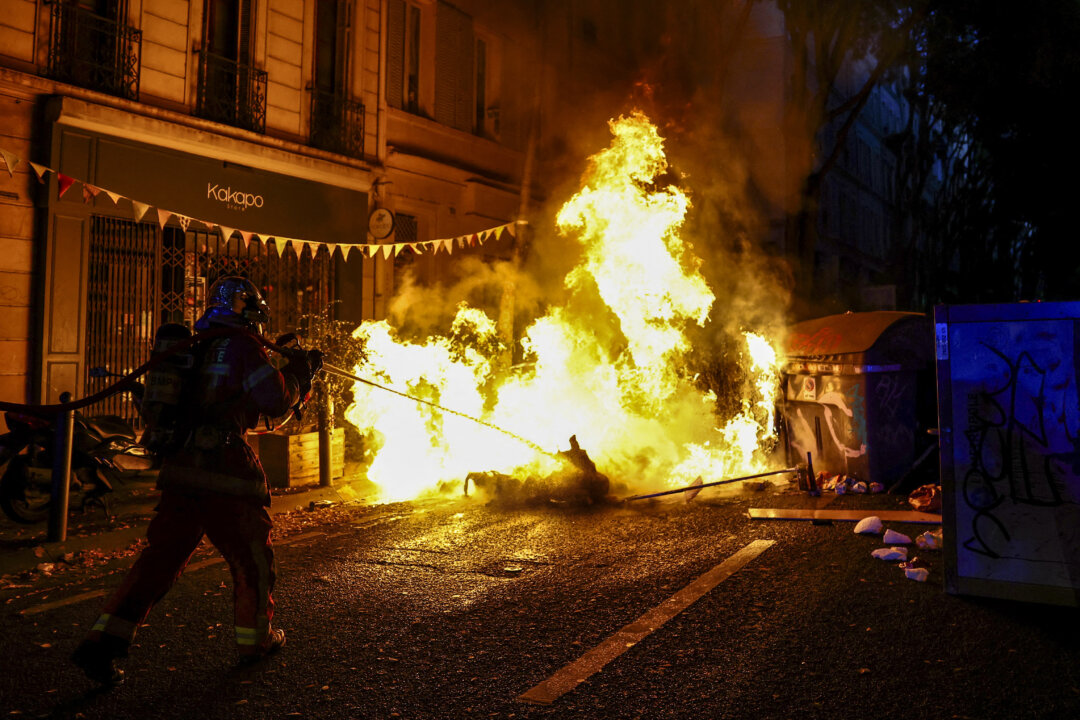
In Marseille, protesters set fire to garbage bins and hurled rocks and bottles at security forces, and several stores, including two jewelry shops, were ransacked, police said.
Interior Minister Laurent Nuñez told reporters on Saturday evening that the day “bears no comparison with last week,” when rioters looted thousands of shops across the country. He nonetheless pointed to a high level of violence in most of the marches.
“In almost every march we saw the formation of these high-risk groups. They broke away from the main body and sought to commit acts of violence,” Nuñez said, blaming far-left activists and criminal gangs.
Nearly 1,000 people had been arrested by Saturday evening, a figure he expected to rise significantly.
Nuñez said checks and searches at train stations and on roads leading to the marches had allowed police to seize many improvised weapons from individuals with “an intent to do harm.”
The Interior Ministry counted 410,000 demonstrators at 289 protests nationwide, down from 550,000 a week earlier, while the CGT union estimated nearly 800,000. In Paris, the ministry put turnout at 110,000, against 250,000 for the union.

French riot police stand guard near Porte de Vincennes during a protest in Paris on Oct. 24, 2026, amid nationwide far-left demonstrations over rising living costs and education funding cuts. Etienne Fauchaire/The Epoch Times
A March in Two Acts in Paris
Authorities banned the traditional Bastille-to-Nation route on Friday evening and confined the Paris march to the southeastern edge of the capital, between Porte d’Italie and Porte de Vincennes, away from a city center where the Louvre and other museums were closed and storefronts boarded up.
For two hours, the procession moved along the outer boulevards without incident, although anti-police chants such as “ACAB” and “everyone hates the police” rang out from many parts of the crowd.
Many protesters also chanted far-left slogans, including “Down with the state, the cops, and the fascists.”
Jean, a 21-year-old student, told The Epoch Times he had come “because I don’t want to let the government repress the movement, and to show that it cannot count on it wearing off.”
Alice, 27, who is currently unemployed, told The Epoch Times she wanted to “send a message before the presidential election.”
“The far right will not be able to reach power without the people making it clear they don’t want fascism ruling France,” she said.

A masked protester carries a French flag bearing an Antifa symbol during a demonstration in Paris on Oct. 24, 2026, amid nationwide far-left protests over rising living costs and education funding cuts. Etienne Fauchaire/The Epoch Times
The mood changed at around 5:30 p.m., when police blocked the main roads around Porte de Vincennes to disperse the crowd. Masked youths hurled projectiles and fireworks at officers, who, after repeated warnings by megaphone, fired water cannons and tear gas at a group of hundreds of hooded individuals.
Clashes Nationwide, but Damage Limited
Unlike Oct. 17, when confrontations began as early as 2 p.m., the first clashes this time came only at the end of the marches. Violence was reported in Lyon, Bordeaux, Grenoble, Clermont-Ferrand, Lille, Rennes, Nantes, and Toulouse.
In Marseille, several stores in the city center were attacked, and 17 people were arrested, AFP reported. In Nantes, where 15,000 people marched despite a ban, masked groups fired mortar-type fireworks and threw stones at police, who held their line. A jewelry store was looted.
In Bordeaux, demonstrators threw projectiles and cobblestones torn from the ground at police on Place de la Bourse, barricades burned on Quai Richelieu, and the facade of the chamber of commerce was targeted again, Sud Ouest reported.
In Grenoble, some 400 masked individuals attacked police with fireworks and projectiles, according to the prefecture, while in Limoges clashes took place in front of the city hall gutted by fire during last week’s riots.

A protester holds a placard reading “Long live our dreams of revolution, no truce to insurrection” during a demonstration in Paris on Oct. 24, 2026, amid far-left nationwide protests over rising living costs and education funding cuts. Etienne Fauchaire/The Epoch Times
The minister credited the difference from Oct. 17 to the security operation mounted after authorities conceded they had underestimated the scale of last week’s unrest, with 70,000 officers—10,000 more than a week earlier—backed by helicopters and armored vehicles. “What changed was anticipation,” he said.
Another protest has been called for next Saturday, Oct. 31.







 English (US) ·
 Turkish (TR) ·
