
News Analysis
In a quiet administrative move late last month, the Department of Civil Affairs in China’s eastern province of Jiangsu banned 12 grassroots civic organizations. They were labeled as “illegal social organizations.”
Seven of the banned groups were volunteer emergency rescue teams, while the rest included house churches, clan associations, and charitable volunteer groups who have provided relief to victims during disasters.
The official statement cited standard bureaucratic reasons for the ban, claiming that the groups were operating without state registration. However, human rights observers and civic organizers in China say the sweep is part of deliberate efforts to maintain state control of information during China’s natural disasters, including their severity, their actual death tolls, and their impact on local residents.
The observers warn that Beijing is systematically moving to eliminate independent groups that witness, record, and expose the Chinese Communist Party’s (CCP) governance failures and slow responses during emergencies.
Silencing Witnesses
The Jiangsu provincial government’s decree targeted local branches of China’s emergency rescue networks, including the International Emergency Rescue Center Jiangsu Provincial Headquarters. Notably, the official announcements for the ban did not accuse the groups of any financial fraud, safety violations, or misconduct. Their only violation was lacking official state approval.
Mr. Zhong, a Jiangsu-based civil rights activist who provided only his surname out of fear of retaliation from the regime, told The Epoch Times that volunteer teams often arrive at disaster areas well before officially dispatched teams do.
This embarrasses the authorities in two ways, he said. “Whenever civilian rescue teams arrive on the ground, they post photos and videos showing the real situation of local victims. This is something that authorities often want to downplay with their own narrative,” Zhong said.
Secondly, “In doing so, these rescue teams unintentionally expose the incompetence, neglect, and inaction of local officials. This kind of information spreads quickly online, so naturally, the authorities do not want the civilian rescuers there.
“The real goal behind Jiangsu’s ban is to prevent independent teams from exposing official failures,” he said.
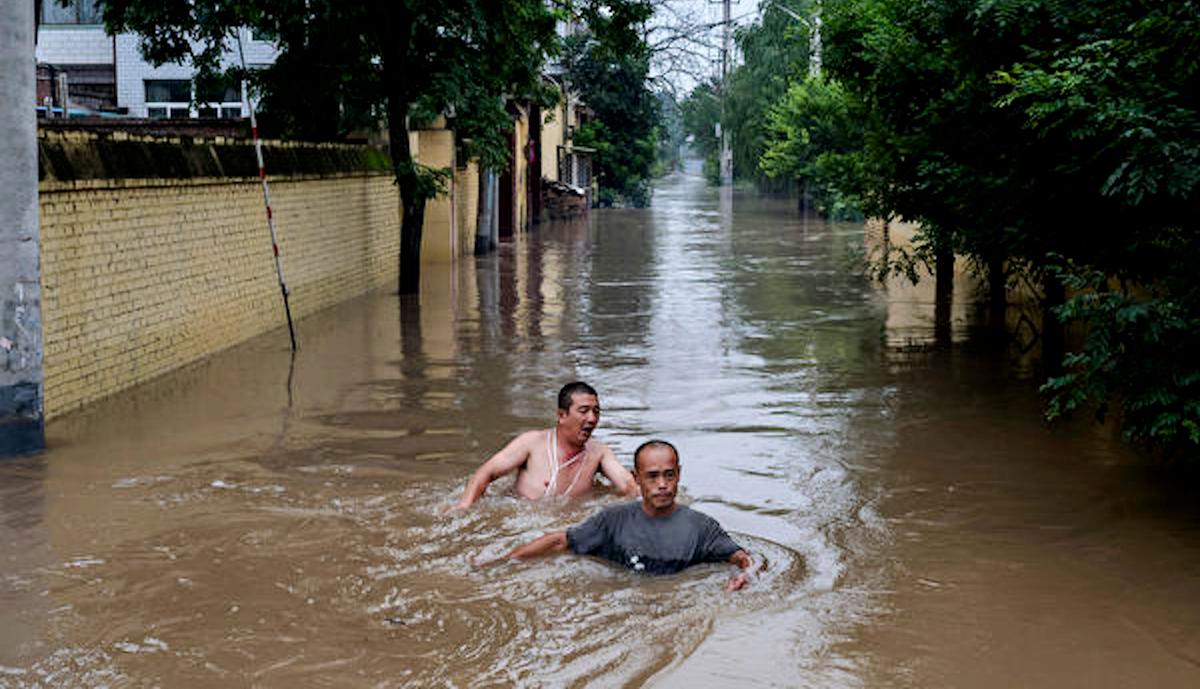
Local residents struggle in deep, fast-moving water as they make their way toward rescuers in a boat in a flooded area near Zhuozhou, Hebei Province, south of Beijing, on Aug. 3, 2023. Kevin Frayer/Getty Images
People who spoke to The Epoch Times say the regime’s intent is to maintain absolute control over society.
Mr. Zhu, a veteran nongovernmental organization volunteer in eastern China who also withheld his full name to avoid state reprisals, said police have closely monitored independent charities for years, and take action when the charities cross any red lines.
Mr. Su, a researcher studying nongovernmental organizations in Henan Province, who likewise provided only his surname out of fear of regime punishment, said he also believes the CCP’s primary fear is losing control to independent groups.
“What the authorities fear most is civilian rescue groups expanding in size and influence,” Su said. “If more people join and form regional networks that can send supplies back and forth across provincial lines, the party views that as a potential threat to its rule. The moment an organization operates outside total party control, officials fear it could challenge their authority.”
Su pointed to the floods in Henan Province just weeks earlier in mid-August. Following torrential rains from Typhoon White Dolphin, state media outlets ran celebratory reports claiming authorities had evacuated over 73,000 residents and achieved “zero casualties.”
In reality, unannounced reservoir discharges and nighttime dike collapses in cities such as Zhoukou and Pingdingshan submerged entire townships. While local residents and volunteer rescue teams reported drowning deaths and recovered victims from the floodwaters, local authorities moved quickly to scrub these casualty reports from the internet.
“The authorities publicly claim that nobody died and that everyone was safely moved, but civilian rescue teams on the ground actually see how many people drowned,” Su said. “The CCP fears nothing more than having its cover-ups exposed. Rather than risk being found out, they simply ban the rescue teams altogether.”
Slow Response and Propaganda
The aggressive move by Jiangsu Province against volunteer rescuers took place almost at the same time the world witnessed the sluggish emergency response of the Chinese military during the Aug. 26 cross-border disaster.
On Aug. 26, a massive debris flow destroyed the Gyirong Port border crossing between China and Nepal, burying hundreds of people. The disaster caused heavy casualties along the international border. As of Sept. 8, authorities in Nepal reported 1,357 deaths and 5,326 missing persons. On the Chinese side, state media claimed only 43 people were killed and 519 remained missing as of Sept. 6. More than 850 of the deceased or missing individuals on both sides of the border were citizens of other countries.
Across the border, Nepal’s military mobilized almost its entire small helicopter fleet—fewer than a dozen working aircraft—to fly continuous rescue missions, evacuating injured survivors and retrieving bodies.

Army personnel carry a person on a stretcher at an army rescue camp in Trishuli Batar, Nepal, on Aug. 27, 2026. Hundreds were reported missing after a sudden flood swept through the Bhote Koshi River basin in northern Rasuwa on Aug. 26. Ritesh Shukla/Getty Images
In contrast, Shen Zhou, a military analyst and contributor to The Epoch Times, described the Chinese military’s response as largely performative in a recent commentary for the publication’s Chinese-language edition. Despite boasting an estimated 1,500 helicopters across 15 army aviation brigades, the Chinese military failed to mount an effective rescue operation, Shen wrote.
Shen based his analysis on reports published by Chinese state-run outlets, including Xinhua and the military’s official newspaper. While state media heavily praised the authorities’ response, Shen pointed out that the published timelines and operational details revealed how little was actually done on the ground.
According to official accounts cited by Shen, following high-profile rescue orders from top officials in Beijing, the Western Theater Command deployed only a single drone to inspect the disaster site, while the Tibet Military District sent just a small advance command group.
While roads to the disaster zone were blocked by heavy mud and debris, Shen noted that helicopters were desperately needed to reach trapped survivors during the critical 72-hour rescue window. Instead, the military flew only limited reconnaissance flights and did not send helicopters to rescue people on the ground. Ground troops were left to hike on foot through deep mud and remained stalled miles away behind destroyed roads.
By Aug. 29—well past the initial 72-hour window when survivors are most likely to be found—state media admitted that road-clearing crews were still over a mile from the disaster site, with only about 70 firefighters reaching the central zone. Two military helicopters were finally sent on the fourth day, but only to drop off supplies from the air rather than land to search for victims.
It was not until 10 a.m. Beijing time on Sept. 2—a full seven days after the disaster—that the main access route to the core disaster area was largely cleared. While state media praised the official response, Shen noted that the military’s delays meant the most vital window to save lives was squandered.
When Nepal’s official disaster authority reported that 13,101 people had been rescued in its Sept. 5 update, a Chinese netizen, through analyzing state media reports, joked online: “Meanwhile, China rescued two people and arrested 10 for spreading rumors online. In other words, following the disaster, the number of people arrested by the CCP outnumbered the number of people rescued by the CCP.”
The alleged rumors were social media posts estimating that thousands must have died in the disaster based on catastrophic landslides seen in circulating footage and the heavy death toll reported in neighboring Nepal.
A Recurring Pattern From Yushu to Jiangsu
This decision to prioritize political image over humanitarian rescue has been repeatedly seen in recent Chinese history.
In April 2010, a powerful earthquake hit Yushu, a Tibetan area in Qinghai Province, killing thousands of people. The first assistance to arrive was not Chinese soldiers, but thousands of local Tibetan Buddhist monks. Rushing from nearby monasteries into the rubble, the monks pulled survivors out with their bare hands, took care of orphaned children, and ran public kitchens that fed around 100,000 displaced residents. Over the following days, nearly 10,000 monks from surrounding Tibetan areas joined the effort, becoming the main rescue force.

Tibetan Buddhist monks distribute relief goods from a truck after an earthquake in Jiegu, Yushu County, in China's northwestern Qinghai Province, on April 19, 2010. Getty Images
However, the large-scale relief work by the monks embarrassed authorities in Beijing. Li Changchun, the senior official in charge of party ideology at the time, ordered state media to focus coverage strictly on the actions of the army and police, completely ignoring the crucial work done by the monks. When then-party leader Hu Jintao visited the disaster zone, his key directives included strengthening propaganda and news control to maintain stability.
Beijing also rejected international search-and-rescue teams during the Yushu earthquake, claiming the disaster zone offered limited space and poor transportation access.
Chen Pokong, a political commentator and author who analyzed the response at the time, dismissed those official explanations, pointing out that professional international teams are trained specifically to operate in difficult and remote conditions. Chen wrote that Beijing’s refusal of foreign aid reflected a longstanding pattern dating back to the catastrophic 1976 Tangshan earthquake, when the regime similarly closed its doors to outside help.
According to Chen, the real motive behind barring outside teams was to tightly control the flow of information, conceal the true death toll, and cover up the shoddy construction of collapsed public schools—widely known as “tofu-dreg” buildings. Chen noted that the authorities also ignored appeals from the Tibetan spiritual leader, the Dalai Lama, who was born in Qinghai and had offered to travel to the disaster area to comfort survivors.
Jiang Fei contributed to this report.








 English (US) ·
  Turkish (TR) ·