
Germany’s chancellor accused Russia of planning the attempted drone attack on a Leipzig airport in August for months.
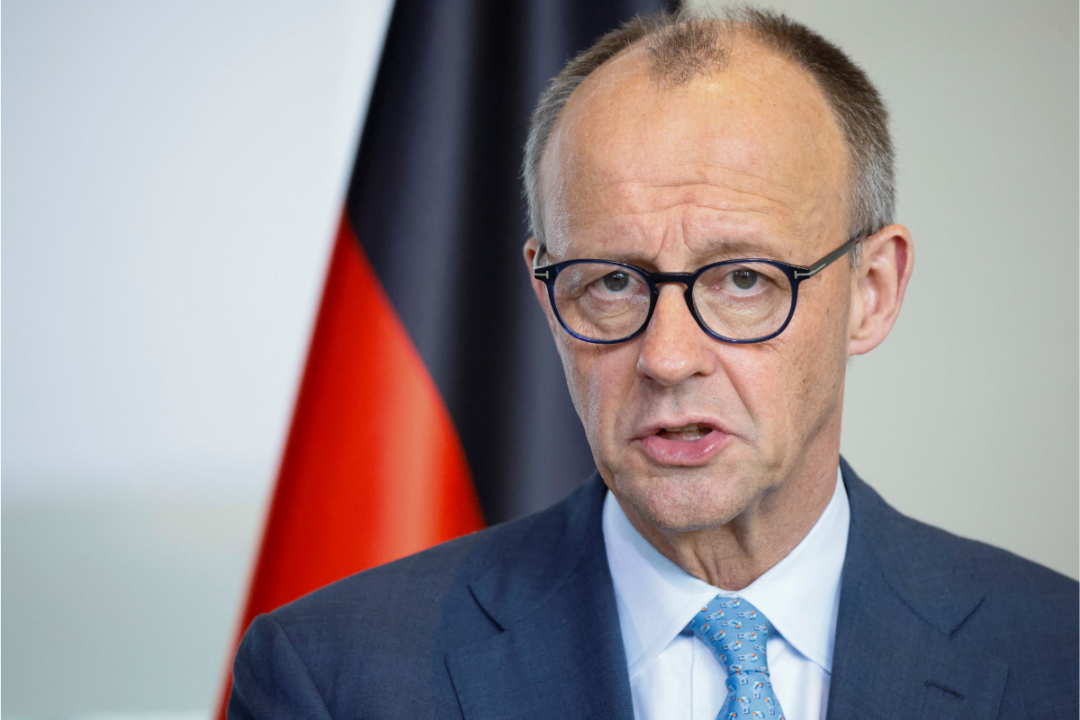
“This attack was planned in Russia for months and was specifically targeted at Germany, and only by pure chance was major material damage and harm to people prevented,” German Chancellor Friedrich Merz said on Sept. 9 during a session of parliament.
Merz’s comments follow Berlin’s action last week officially pinning the blame on Moscow for the Aug. 4 attempted drone attack on Leipzig/Halle Airport.
German authorities had said that an unmanned aerial vehicle (UAV) laden with explosives was found last month near a Ukrainian cargo plane at the airport, and the device was defused. They said on Sept. 1 that the attempted strike would have been a “serious attack” on the country’s national security and infrastructure.
The Russian Embassy in Berlin said at the time that the ambassador, Sergey Nechaev, “resolutely rejected Berlin’s accusations as unsubstantiated, absurd, and contrary to common sense.”
Russian Response
On Sept. 9, Russian Foreign Ministry spokeswoman Maria Zakharova criticized what she described as hysteria following the drone incident, saying it is being used to facilitate false accusations against Moscow.
“We view this latest episode of anti-Russian hysteria in Europe as a pre-planned escalatory maneuver, sanctioned by the EU and NATO leadership bound by mutual complicity, and having nothing to do with an objective investigation,” Zakharova said at a briefing in Syktyvkar, according to the Russian state-run news agency TASS.
“It is obvious that the goal and objective of such actions is to maintain a high level of Russophobia within European society” in order to mask political and economic miscalculations by European leaders, she said.
Main Base for NATO Deliveries
Leipzig/Halle Airport is a key cargo hub and military airport in the eastern German state of Saxony.
It is also the main base for NATO’s Strategic Airlift International Solution, and among other functions, transports equipment to strengthen the defense pact’s eastern flank using a small fleet of Ukrainian-made Antonov cargo planes.
German authorities said in the days after the incident that airport workers spotted the drone late on Aug. 4, and that a bus driver who was working at the airport “kicked” the low-flying, explosive-laden UAV out of the air. It then crashed nearby.
Flights were suspended following the incident, affecting other companies that use the airport as a cargo hub, including German logistics group DHL, German Lufthansa Cargo, and Amazon.
German Interior Minister Alexander Dobrindt described the incident as a “hybrid attack,” which falls short of an act of war and can include sabotage, propaganda, and other non-overt tactics.
Then on Sept. 1, Dobrindt said at a press conference alongside Foreign Minister Johann Wadephul in Berlin that, following an investigation, Berlin had concluded that Russia was responsible for the attack.
The interior minister said that a UAV, explosives, and a detonator, similar to others recovered from previous Russian hybrid operations, had been seized at the scene of the incident. He said that though the planning was considered to be professional, the act itself had been attributed to “low-level agents” who “acted on behalf of Russian state authorities.”
Dobrindt also stated that he did not view the Leipzig incident as “isolated,” but rather as part of other hybrid actions.
Reuters and Guy Birchall contributed to this report.





 English (US) ·
  Turkish (TR) ·