

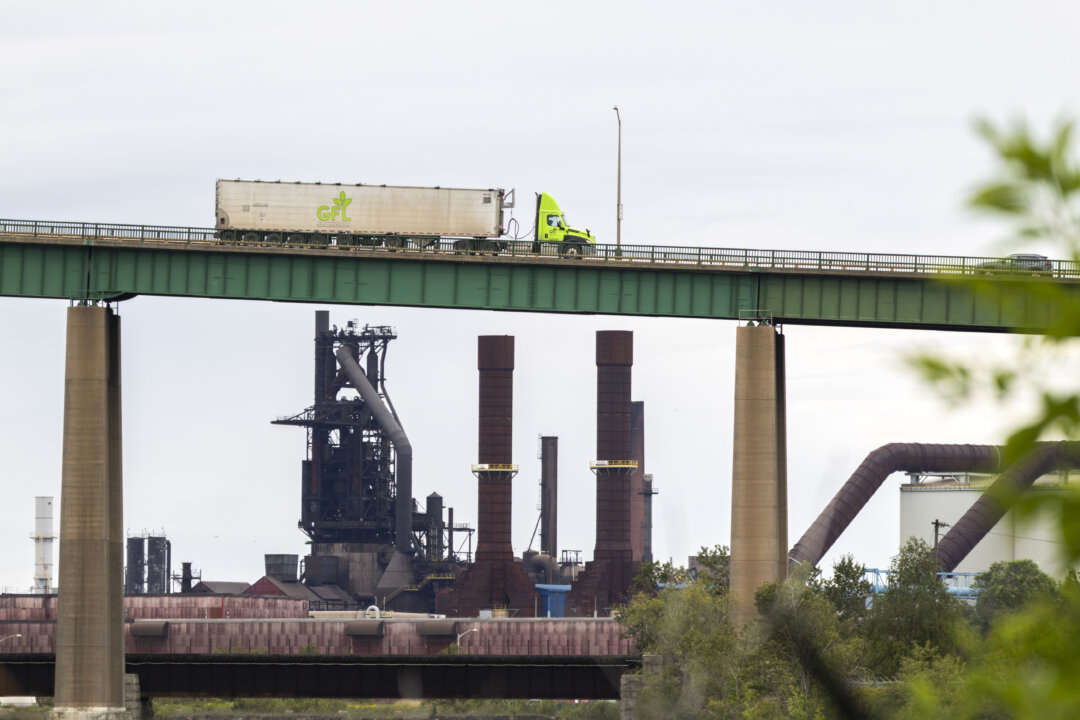
A transport truck crosses the Sault Ste. Marie International Bridge toward the United States on Sept. 4, 2026. The Canadian Press/Nick Iwanyshyn
Commentary
The collapse of Canada-U.S. trade negotiations, the subsequent imposition of 50 percent American tariffs on US$20 billion worth of Canadian goods, and Ottawa’s dollar-for-dollar retaliation have dominated the national conversation. Both sides made comments that caught attention, and the cameras obliged.
Lost in the noise was a more uncomfortable question: Why is Canada so fragile that a trading partner’s policy shift—however aggressive—threatens the foundations of our prosperity?
The honest answer has less to do with Washington than with Ottawa, and with decades of decisions that left this country uniquely exposed and economically anemic.
The Tariff We’re Not Talking About
The U.S. tariffs are real, and their costs are real. The political costs of this conflict are being felt on both sides of the border.
But let us be precise about the scale of the Canadian problem that preceded these tariffs. Canada’s internal trade barriers—the regulatory walls between provinces that prevent a contractor licensed in Ontario from working freely in Alberta, or a wine producer in B.C. from selling directly into Quebec—cost the Canadian economy an estimated $130 billion or more annually. That is not a number imposed by Washington. That is a number we impose on ourselves, year after year, by political choice.
And that is before accounting for a corporate and investment tax environment that consistently ranks among the least competitive in the developed world; a regulatory approval process for major projects that routinely takes a decade or more; and, perhaps most damning, a federal and provincial government that spent $87.7 billion on corporate subsidies in 2024 alone, according to a recent Fraser Institute study. That figure has more than tripled since 2015. Rather than building competitive businesses, we have been building dependency.
The picture that emerges is not of a country ambushed by a hostile trade partner. It is of a country that entered the fight already carrying a weight of its own making. This is less a battle than a reckoning.
The Opportunity We Keep Refusing
Here is the argument that almost nobody in Canadian political life is making: This crisis is an opportunity.
Not an opportunity to retaliate, or to build a new national identity around anti-American sentiment, though both are being proposed. An opportunity to finally do what Canada should have done decades ago.
Consider the arithmetic. Credible estimates put the cost of Canada’s internal trade barriers alone at over $130 billion annually—more than four times the value of goods currently subject to the new American tariffs. Eliminating corporate subsidies and redirecting that $87.7 billion toward broad-based tax relief, as the Fraser Institute recommends, would transform the investment environment almost overnight. A serious deregulation agenda could conservatively unlock three to four times more economic value than the entire tariff drag costs us.
A country that reforms itself into a genuinely competitive economy is not at the mercy of any single trading partner’s political mood. A country that doesn’t reform remains perpetually vulnerable—not because of what others do to it, but because of what it does to itself.
The trade deal will eventually be renegotiated—economic reality on both sides of the border demands it. What will not change automatically is Canada’s underlying competitiveness. That requires choices that are harder than retaliation and less satisfying than national solidarity rhetoric.
Views expressed in this article are opinions of the author and do not necessarily reflect the views of The Epoch Times.









 English (US) ·
  Turkish (TR) ·