
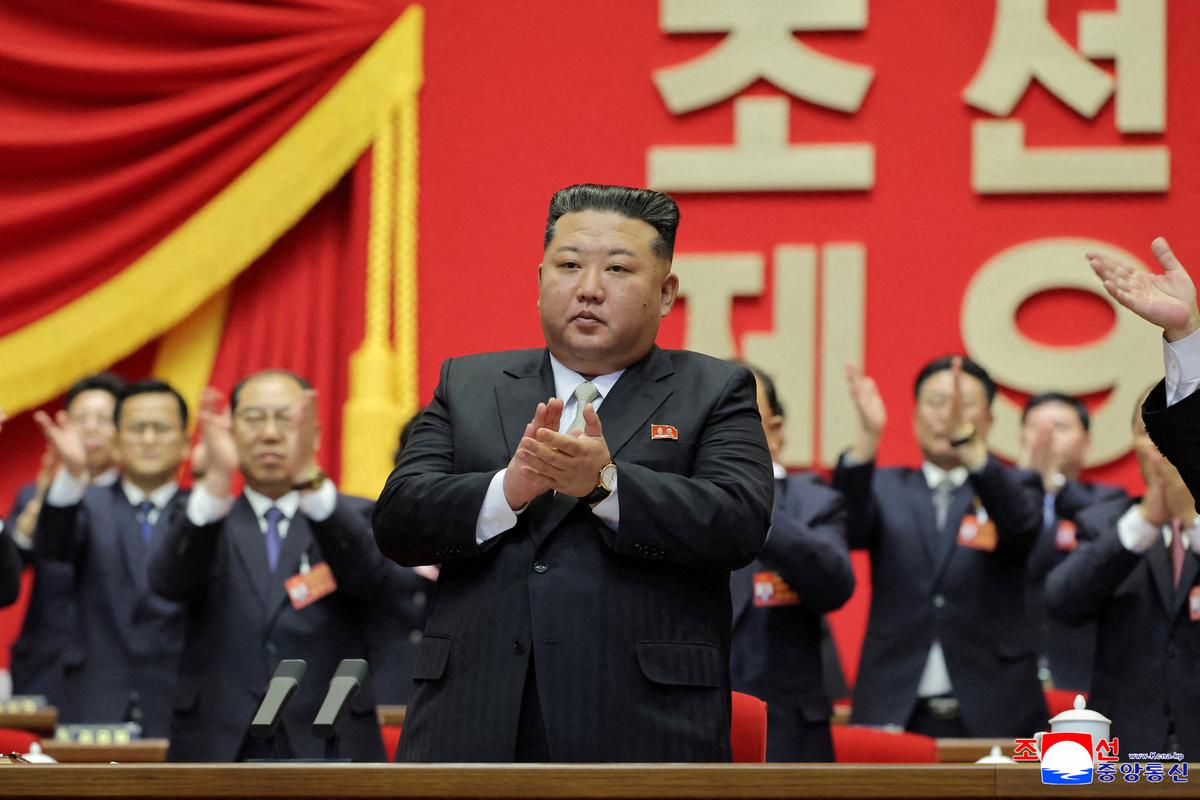
North Korean leader Kim Jong Un applauds in Pyongyang on Feb. 22, 2026. KCNA via Reuters
The United Nations’ nuclear watchdog said North Korea has expanded uranium enrichment capacity at its Yongbyon and Kangson facilities, describing the developments as a cause for serious concern.
The International Atomic Energy Agency (IAEA) said that Pyongyang has built a second uranium enrichment facility at its main Yongbyon nuclear complex that could house up to 28 centrifuge cascades.
The findings, published in the agency’s Aug. 28 report, also showed that an annex added to the Kangson facility between February and April 2024 increased the site’s floor space. Satellite imagery suggests operations inside the annex began in January, the agency said.
The assessment is based on commercial satellite imagery, the IAEA said, as well as open-source information, including photographs released by North Korean state media.
The watchdog has not had inspectors inside North Korea since April 2009. IAEA Director General Rafael Grossi said that despite not having access to the country, the agency continued to monitor North Korea’s nuclear program.
“The ongoing operation of enrichment facilities at Kangson and Yongbyon and the reported further expansion of the DPRK’s production of weapons-grade nuclear material is a cause for serious concern,” Grossi told the agency’s board of directors on Monday.
North Korea has about 50 nuclear warheads and enough fissile material to produce up to 40 more while accelerating further production, according to a 2025 report by the Stockholm International Peace Research Institute.

North Korea’s main nuclear complex in Yongbyon, North Korea, on July 27, 2021. Planet Labs Inc. via AP
Grossi had previously warned about North Korea’s expansion program.
He noted on June 8 that North Korean leader Kim Jong Un visited a “newly inaugurated nuclear materials production factory” on June 3 and spoke about developing the country’s capacity to produce weapons-grade nuclear material.
“Photographs taken during Kim’s visit show centrifuges and cascades similar to those depicted in previously released images of DPRK enrichment facilities,” Grossi told the agency executives at the time, using the abbreviation of North Korea’s official name, the Democratic People’s Republic of Korea.
He added in Monday’s statement that indications suggest Yongbyon’s 5-megawatt reactor likely continues operating in its seventh irradiation cycle. After a period of shutdown, Grossi said, the light-water reactor at Yongbyon has been operating since the end of April 2026.
The latest IAEA findings come as diplomatic attention remains focused on North Korea’s nuclear program.

President Donald Trump meets with North Korean leader Kim Jong Un at the North Korean side of the border at the village of Panmunjom in the Demilitarized Zone, on June 30, 2019. Susan Walsh/AP Photo
U.S. President Donald Trump said on Aug. 19 that he planned to meet Kim later in the year. The two leaders met three times in 2018 and 2019 during Trump’s first term, before negotiations over Pyongyang’s nuclear arsenal collapsed.
Earlier this year, Kim said relations between Washington and Pyongyang could improve if the United States drops what he described as a hostile policy.
He also warned that North Korea would continue expanding its nuclear arsenal and prepare for confrontation if necessary.
In June, leaders of the G7 countries reaffirmed their commitment to the complete denuclearization of North Korea in accordance with U.N. Security Council resolutions.
“The continuation and further development of the DPRK’s nuclear programme are clear violations of relevant UN Security Council resolutions and are deeply regrettable,” Grossi said on Monday.




 English (US) ·
  Turkish (TR) ·