
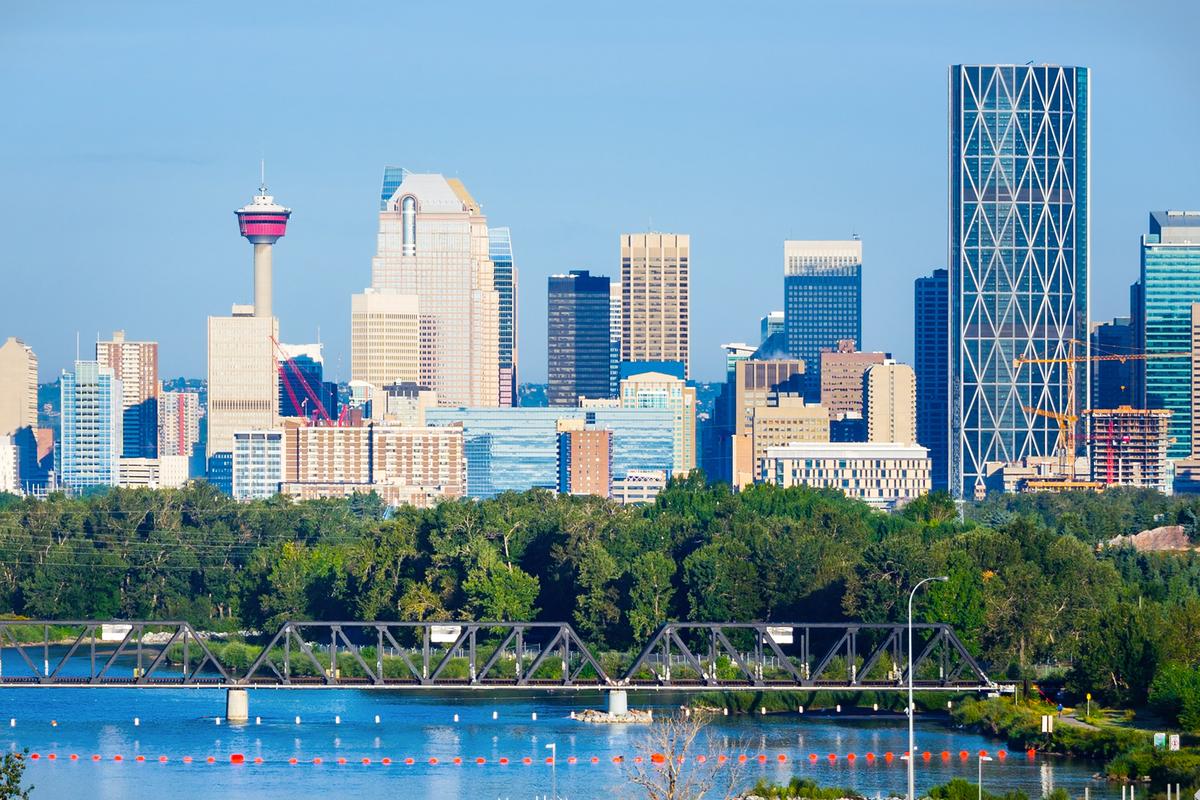
A view of Calgary's downtown core on June 30, 2025. Shutterstock/Andrew Zarivny
Calgary city council is considering increasing annual spending on concrete infrastructure repairs to $37 million over the next decade as the city faces a $246 million backlog of safety-related repairs and upgrades.
A new report from city administration recommends that council allocate $37 million annually to reduce safety hazards by 72 percent. The recommendation is set to go before the Infrastructure and Planning Committee on Sept. 9. According to the report, the investment would reduce the number of identified safety issues from 53,326 to 15,996 by 2036.
The report estimates that the city’s $246 million backlog is tied to safety-related repairs and upgrades needed to address aging sidewalks, curbs and gutters across Calgary.
“Funding levels have not always been consistent year to year [and have ranged from $3 million to $9 million], and they do not factor in expected growth of the network,” administration wrote.
At current funding levels, the report projects that “Calgary’s sidewalk quality will continue to decline, and the safety hazard backlog will increase [from $246 million] to $265 million by 2036.”
Of the proposed $37 million in annual funding, administration recommends spending $24 million on sidewalk repairs and $13 million on curbs and gutters.
The report said this would maintain 54 percent of sidewalks in “good” condition, with none rated “poor.” It would also maintain 78 percent of curbs and gutters in good condition, with zero rated poor.
The current assessed condition of Calgary’s sidewalk network is rated as 67 percent good, 31 percent fair, and 2 percent poor. At current funding levels, forecasts estimate that good-condition sidewalks will decrease to 48 percent by 2036.
The city’s freeze-thaw cycle is one factor that contributes to the deterioration of sidewalks, while moisture infiltration, poor drainage, tree root growth, water leaks, and utility excavations also contribute to the infrastructure’s degradation, the report said.
Calgary has roughly 7,044 kilometres of concrete curbs and gutters and adds 86 kilometres per year, with 79.3 percent rated as good, 20.2 percent rated as fair, and 0.5 percent rated as poor.
“Implementing concrete repairs at the right time is the most cost-effective and efficient approach to maintaining a resilient concrete network,” administration wrote. “However, without the proper intervention, concrete condition can deteriorate rapidly and reach a ‘poor’ state in less than 25 years.”
The report noted that concrete typically lasts about 50 years in Calgary, although “empirical evidence” shows the average lifespan is 20 to 40 years.
Overall, the city’s concrete assets total 13,289 kilometres, are valued at $7.4 billion, and city hall has spent roughly $5 million per year over the past seven years on those capital projects, the document said.
City administration worked with Toronto Metropolitan University to forecast Calgary’s concrete quality over 10 years. The educational institution provided four suggestions on the different levels of service investment the municipality could pursue.
The options range from continuing to spend $5 million per year, under which sidewalk conditions would deteriorate, to $131 million per year to repair 100 percent of backlog items and maintain sidewalk conditions at 67 percent.
The report also highlighted how 71 percent of respondents to a spring survey said the city should prioritize improving sidewalks’ surface conditions when making budget decisions, while customer service requests about concrete conditions had increased by six percent from 2024 to 2025.






 English (US) ·
  Turkish (TR) ·