
The potential sale of Victoria’s last warship-building shipyard has raised concerns among defence analysts.
Once owned by BAE Systems Australia, the shipyard was listed for sale in 2024, before being sold in 2026 to Australian business EMKC3, which is part-owned by Hong Kong-based EMKC Group.
The Williamstown Shipyard is located in Melbourne opposite to the busy Port of Melbourne and is being sold for around A$200 million with reported plans to build residential apartments, retail, and light industry in the area.
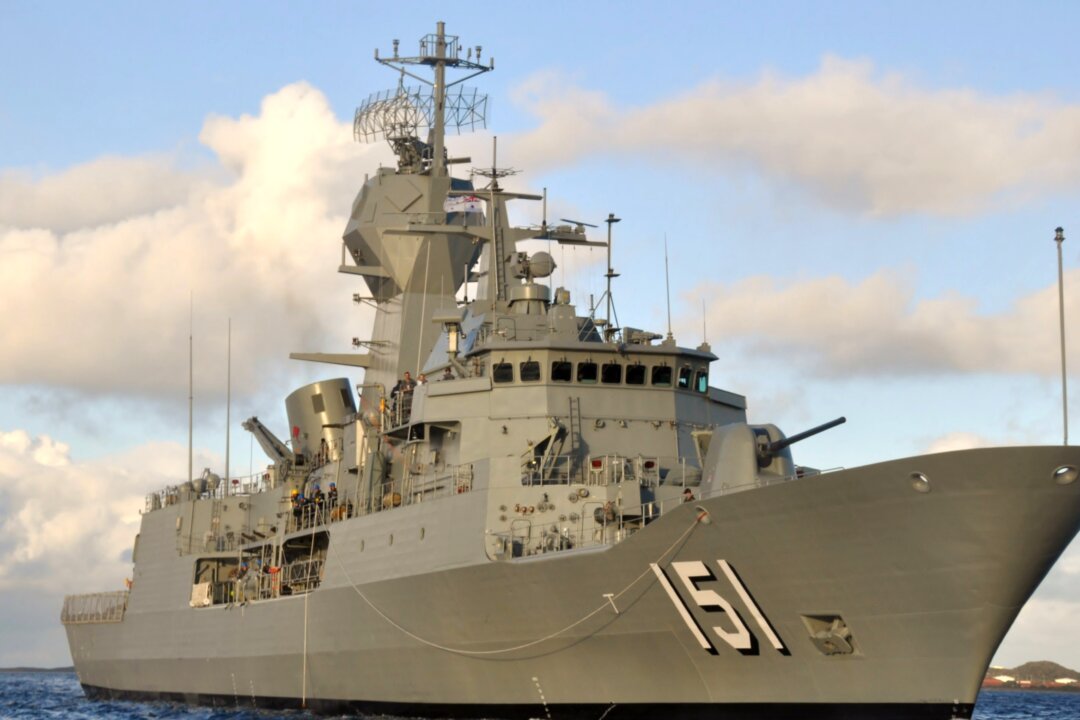
Williamstown Shipyard was used to construct all 10 ANZAC class frigates for Australia and New Zealand, as well as performing work on Landing Helicopter Dock vessels, HMAS Canberra and Adelaide.
The shipyard was first sold off by the Commonwealth under Labor’s former Defence Minister Kim Beazley in 1988 to the Australian Marine Engineering Corporation (AMEC).
Since then, Williamstown Shipyard has changed private hands a number of times.
Regarding the latest sale, the Victoria government says the facility must adhere to its intended purpose, even under private control.
“The Victorian Planning and Environment Act requires that the Williamstown Shipyard Site continues to be used for industrial and marine engineering purposes,” a spokesperson told The Epoch Times.
Williamstown is considered the last shipyard in Victoria capable of building warships.
‘Dangerous Political Decision’
Security expert and academic Paul Johnstone says the sale needs transparency.
“I believe all Australians should be very concerned about the proposed sale of Williamstown Shipyard,” the former Australian Federal Police agent told The Epoch Times. “The reported buyer is an Australian developer part-owned by a Chinese company based in Hong Kong.”
“The public deserves to know what influence that shareholder would have over the yard’s future.”
Johnstone said allowing the sale to go ahead without a proper security assessment was a “dangerous political decision.”
“It would undermine democratic accountability and put the integrity of our defence capability at risk.”
Johnstone said the government “should have learned” from the decision to grant Beijing a 99-year lease on the Port of Darwin, which is now subject to significant dispute among political leaders and security experts.
“[Beijing’s] ongoing military-civil fusion strategy includes securing access to civilian ports, transport and logistics networks that can support its armed forces and give it a strategic advantage,” Johnstone said.
He also questions whether the Royal Australian Navy will still have access to Williamstown and and if any counter-intelligence measures are in place.
“Who would ultimately control access to the yard in the event of a military incident involving China in the Asia Pacific region and what enforceable guarantee would the navy have that it could use Williamstown when Australia needs it?” he said.
Australia ‘Favouring Political Outcomes’
Michael Shoebridge, director of Strategic Analysis Australia, says the government has handled its military bases and facilities poorly.
“Henderson’s ‘Maritime Precinct’ in Western Australia is an example of the kinds of troubles and compromises that a politics-driven focus has on actual naval shipbuilding,” he told The Epoch Times.
“With AUKUS into its fifth year, land title issues are still being sorted out in Henderson and these together with the scale of work required to do concurrent naval surface ship and submarine work there makes the initiative far riskier than it needs to be—and slower—in a strategic environment where speed matters.
“Meanwhile, a prime naval shipyard site in Melbourne is being sold off to a property developer, with Chinese connections.”
Shoebridge said the shipyard was in a good location to be further developed given the skilled workforce around the CBD.
“The issue … is not about the security problems from a Chinese-owned apartment development, it is the short term focus on getting a wad of cash for a site that should be rebuilt as a capable modern naval shipyard,” he said.
The sale of Williamstown comes amid the federal Labor government’s broader sell-off of 67 defence sites around Australia, which has drawn firm opposition from the federal opposition, Greens, One Nation, and the Teals.
History of Williamstown
In the 1850s, the Victorian government established the shipyard in response to the Gold Rush, with its first trial for ship repairs taking place in 1856.
By 1874, the Alfred Graving Dock had opened, with HMAS Nelson the first naval vessel to enter it.
In 1913, ships were being built at Williamstown, and in World War II it became a major site for naval construction, which it continued until 2016.








 English (US) ·
 Turkish (TR) ·
