
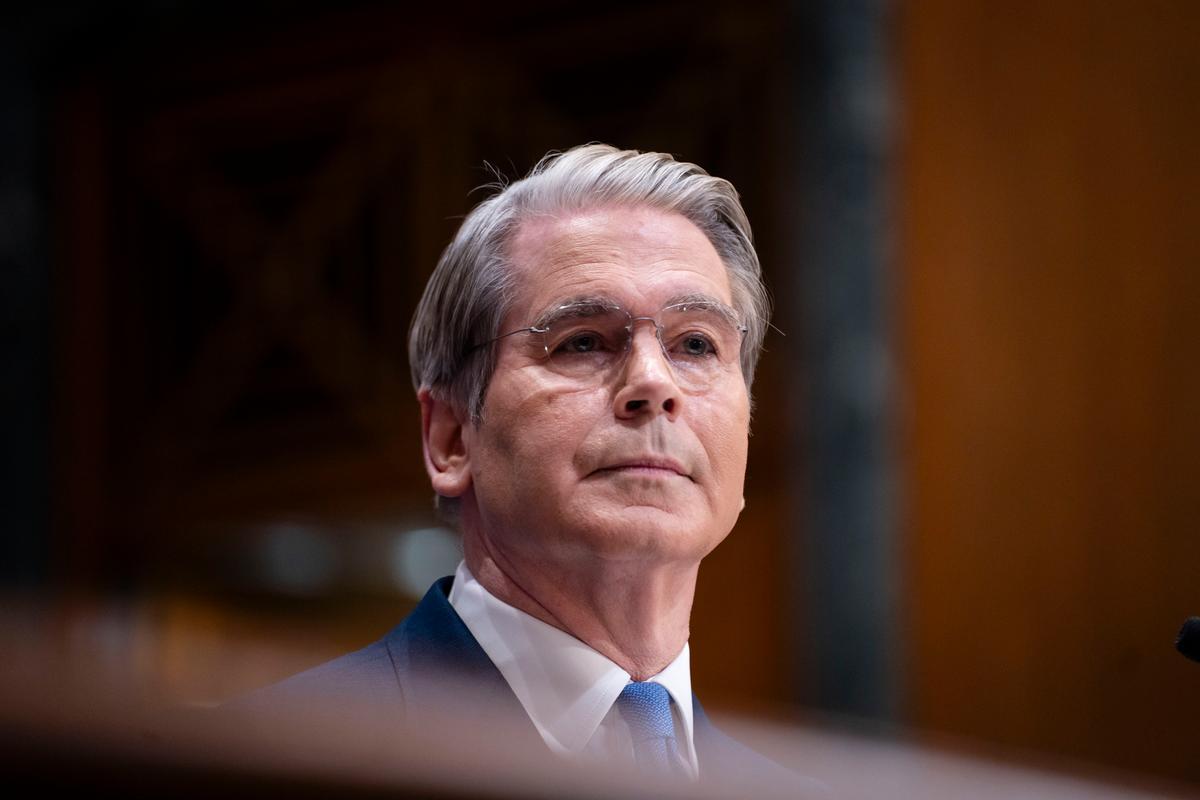
Treasury Secretary Scott Bessent testifies before the Senate Committee on Appropriations in Washington on June 3, 2026. Madalina Kilroy/The Epoch Times
United States Treasury Secretary Scott
Bessent saysthe difference in the size of the Canadian and American economies will make it difficult for Ottawa to respond with reciprocal tariffs.
“I don’t think you can be in a tit-for-tat with somebody 13 times larger than you are,” Bessent said in an interview on CNBC on Aug. 31 when asked if the United States was in a trade war with Canada.
“I mean, we’re not at war with Canada. How are we going to be at war with Canada? What are they going to take their two submarines from the [West] Edmonton Mall and sick them on us?” Bessent added.
Canada’s GDP is approximately $2.51 trillion, compared with about $32.38 trillion for the United States. The U.S. population is also more than eight times larger than Canada’s, at roughly 343 million people compared with 41 million in Canada.
Ottawa has said it will impose dollar-for-dollar, rate-for-rate counter-tariffs on $27.6 billion worth of U.S. imports beginning Sept. 8, after Washington imposed 50 percent tariffs on $27.6 billion worth of Canadian goods effective Aug. 22.
Bessent said it was “unfortunate” that Prime Minister Mark Carney was engaged in what he described as a “political shouting match” with the United States over trade. Bessent also criticized Carney’s approach to the United States, saying he came to office in 2025 on what Bessent characterized as an “anti-American, anti-Trump agenda.”
“And it’s unfortunate that he’s not doing what’s best for the Canadian people. He’s doing what is best for the Liberal party, what’s best for Mark Carney,” Bessent said.
Bessent said that the Canadian government had been offered the “best trade deal of any country in the world” but had chosen not to accept it. Bessent also said he would be discussing trade with Finance Minister François-Philippe Champagne while at the G20 Summit in North Carolina.
Ottawa has accused the United States of imposing additional demands before the Aug. 22 trade deal deadline, with Carney saying Washington “proposed new terms that were uneconomic, unfair, and undermined the net benefits for Canada, and called into question the reliability of any deal.”
Carney said Ottawa did not ask for any last-minute concessions that might have led to talks falling apart, but had clarified what was on offer, and was “continually disappointed by the answers.”
Carney said negotiations broke down in part due to American efforts “to restrict our protections of our language, our culture, and in effect, our sovereignty.” He also said that Washington’s insistence that Canada restrict trade agreements with other nations, and that medium- and heavy-duty trucks be omitted from tariff exemptions, contributed to the collapse.
U.S. President Donald Trump was asked on Aug. 25 if he had imposed additional, last-minute demands on Canada, and he responded, “that sounds like me.” However, U.S. Trade Representative Jamieson Greer later said Trump had made “off the cuff” comments, and that no additional demands had been made.
“The president—we all—felt so comfortable that there was a meeting, there were agreements on specific rates, specific percentages, etc.,” Greer
said on Aug. 27.“Hard to change those things after a given time.”




 English (US) ·
  Turkish (TR) ·