

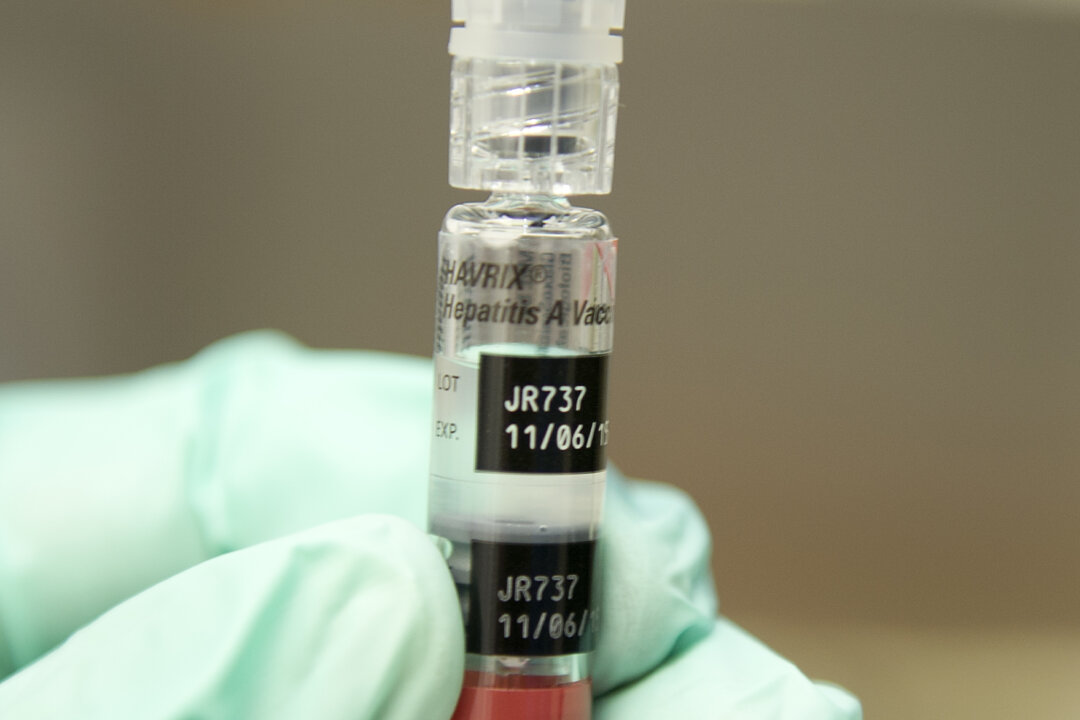
A nurse prepares a vaccine against hepatitis in a file photograph. Robyn Beck/AFP via Getty Images
A study that was set to test the effectiveness of the hepatitis B vaccine will not take place, a researcher involved with the plans said Oct. 21.
The Bandim Health Project of the University of Southern Denmark was going to compare the outcomes of infants in Guinea-Bissau who received two government-recommended vaccines to infants who received those vaccines as well as the shot against hepatitis B.
The necessary governmental approval, though, has not been given, and it is “now clear that the … trial will not move forward,” Dr. Frederik Schaltz-Buchholzer, who works with the project, wrote on LinkedIn on Wednesday.
Schaltz-Buchholzer told The Epoch Times in January that the Guinea-Bissau National Committee of Ethics had approved the trial, but it was on hold as health officials in the country reviewed the protocol. A Danish committee also approved the study.
Thousands of infants would have been enrolled if the trial were allowed to proceed, and at least 17,000 mothers would have been tested for hepatitis B, according to the project.
Critics, including officials with the World Health Organization, said they were concerned that some of the infants in the trial would not receive the hepatitis B vaccine.
“Placebo or no‑treatment vaccine trials are only acceptable when no proven intervention exists or when such a design is indispensable to answer a critical question of efficacy or safety,” the organization said previously. “Neither condition appears to be met based on publicly available descriptions of the study.”
That vaccine is not slated to be on Guinea-Bissau’s vaccine schedule until 2027.
The U.S. Centers for Disease Control and Prevention awarded $1.6 million to help fund the trial. The CDC did not respond to a request for comment on Wednesday.
The announcement came two days after police in Guinea-Bissau said they seized hepatitis B vaccine doses from the Bandim Health Project in Bissau. Police said the seizure was part of an investigation, which is ongoing, and does not mean there were irregularities with the vaccines.
The project has been operating since 1978 in Guinea-Bissau, a country in West Africa with a population of about 2 million.
Studies from the project have been praised by U.S. Health Secretary Robert F. Kennedy Jr.
U.S. officials under Kennedy tried switching away from a universal hepatitis B vaccine recommendation for newborns before a federal judge blocked the update in March.
Schaltz-Buchholzer said on LinkedIn that he believes the trial drew opposition because “it challenged prevailing medical assumptions, such as that [the hepatitis B vaccine] does not have non-specific effects, something that has never been rigorously tested in randomized trials.”
Non-specific effects are unintended consequences or benefits of vaccines.
Schaltz-Buchholzer said the original idea of the trial came from a researcher in Guinea-Bissau who wanted to assess the health impacts of the hepatitis B vaccine before it is rolled out across the country.
“Our project represented an opportunity to generate locally relevant evidence while delivering immediate protection and care to participants and preventing hundreds of cases of chronic hepatitis B,” he said. “Its cancellation is a significant loss for the children and research community of Guinea-Bissau, to whom I remain deeply committed.”







 English (US) ·
 Turkish (TR) ·
