
 1 hour ago
30
The World Food Programme will cut monthly aid to 500,000 people in Gaza due to a funding shortage, despite ongoing food shortages.
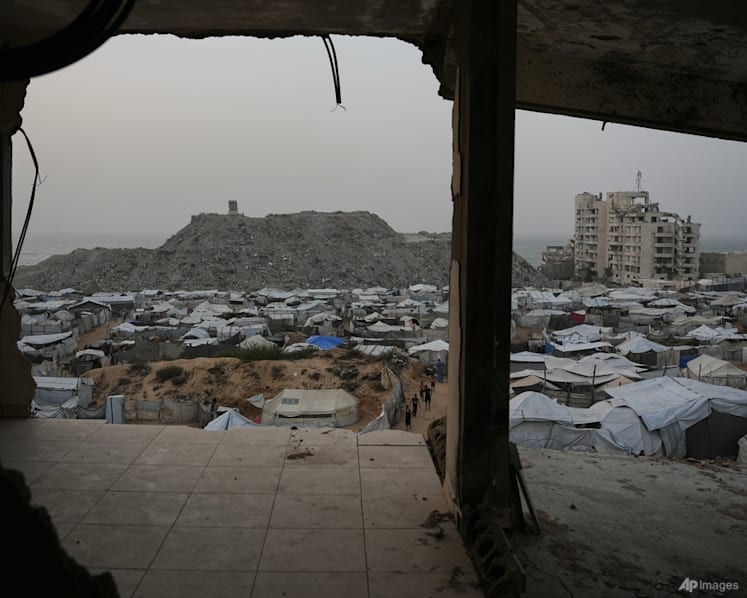
Palestinians walk among tents at a tent camp for displaced people in Gaza City, Friday, Oct 16, 2026. (Photo: AP/Abdel Kareem Hana)
BEIT HANINA, Palestinian Territories: The World Food Programme said Monday (Oct 19) it would end monthly assistance to 500,000 people in Gaza due to a funding shortfall, despite acute needs in the war-battered Palestinian territory.
With the cutbacks, 1.1 million Palestinians in Gaza - still about half the population - will be receiving either food or cash assistance each month from the UN agency, in reduced amounts.
The World Food Programme said its efforts had mitigated the effects during a famine last year in Gaza - an evaluation of the situation disputed by Israel - and warned that conditions had not improved to the point that it can take away aid.
"This has been a lifeline. But now, rather than being able to sustain and scale up that assistance, we're actually having to reduce it," Shaun Hughes, the WFP country director, told AFP at the agency's office in east Jerusalem.
"And that's not because we don't have humanitarian access to deliver food; that's because we don't have funding."
According to the latest assessments, 1.4 million people - or two-thirds of Gaza's population - are still "acutely food insecure" and need humanitarian assistance to survive, he said.
"EXTREMELY DIFFICULT"
Palestinians living in Gaza, where nearly the entire population has been displaced at least once, voiced alarm at the cuts in assistance.
"The hardest thing for a mother is to see her children hungry and be unable to provide food for them," said Samaher al-Najjar, 45, from the southern city of Khan Yunis.
"We live in a tent and do not have the money to buy everything we need. We rely on aid to provide part of our food," she said.
"All we want is for our children to have something to eat every day. The consequences of this would be extremely difficult."
Ayman Daghmash, 40, from Gaza City called news of the cutoffs "frightening".
"The assistance helped us get by for several days, but now we do not know how we will meet our family's needs, especially after community kitchens in Gaza stopped operating some time ago," he said.
"There is also no work or steady income, and food prices are beyond our means. If assistance stops coming from every direction, how will we feed our children?"
The WFP was able to bring in more assistance after a US-brokered ceasefire took effect a year ago. Israel has kept striking Gaza since then, vowing to kill anyone involved in the October 7 attack.
Between 1.5 million and 1.8 million people have been receiving assistance every month.
In addition to reducing the number of people who receive rations, the WFP will shrink the content.
Families receiving food assistance will now get only one food parcel instead of two and a smaller bag of wheat flour, the WFP said in an operational note.
The 75,000 families who receive assistance in cash will see the amount reduced from 1,250 to 750 shekels (US$400 to US$240) per month.
The WFP is funded by governments as well as private donors. It has seen a sharp drop in resources, including after President Donald Trump returned to power in the United States and drastically slashed contributions to UN agencies, as well as bilateral aid.
The agency says it needs about US$450 million over the next six months for its operations in Gaza and the West Bank, but in 2026 it has only received about half the usual financing for the Palestinian territories.
In September, the agency also reduced by half the number of aid recipients in the West Bank, which Israel has occupied since 1967, from 400,000 to 200,000.
Israel has allowed more goods into Gaza under the terms of the Trump ceasefire, but still turns away shipments of anything that is seen as having potential military use - a policy that has included blocking even prosthetic limbs, according to the United Nations.
Israel has ramped up longstanding criticism of the United Nations since the Gaza war, accusing the world body of bias and perpetuating dependency among Palestinians.










 English (US) ·
 Turkish (TR) ·
