

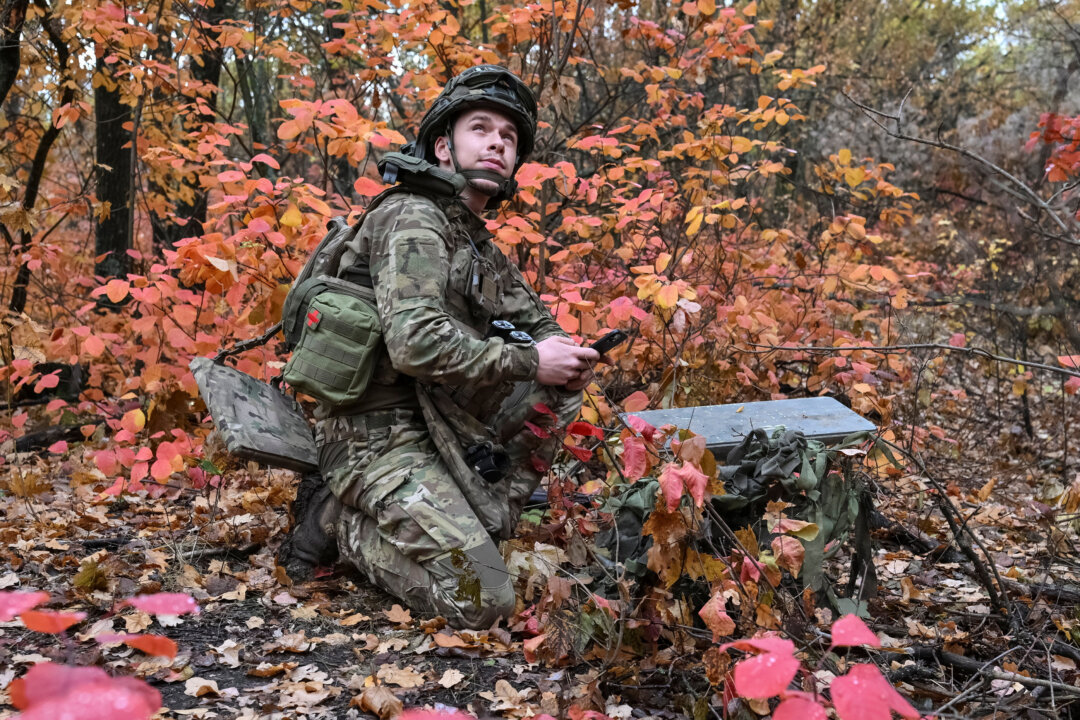
An artilleryman with the Special Rifle Police Battalion of Ukraine's Zaporizhzhia region sets up a Starlink satellite internet system at a position near the front line in Donetsk region, Ukraine, on Oct. 16, 2026. Reuters/Stringer
WASHINGTON—Ukrainian officials, on Nov. 12, reported that their forces are facing new limitations on their Starshield satellite internet service, hindering their ability to intercept Russian attack drones.
In a statement on X, Ukrainian President Volodymyr Zelenskyy said Ukrainian forces have again identified speed restrictions on Starshield-connected devices moving faster than 100 miles per hour. Zelenskyy said the service restriction is particularly problematic in Russian-controlled areas of Ukraine where attack drone barrages commonly originate.
“This directly affects our ability to intercept Russian jet-powered ‘shahed’ drones,” Zelenskyy said. “These drones come from those areas, and because of the speed restrictions, we simply cannot catch up with them in time.”
Ukrainian forces have used Starshield-connected interceptor drones to knock out Russian attack drones.
Zelenskyy said the disruptions to the satellite internet service mean more attack drones can slip past Ukrainian defense “and more of our people are killed by Russia.”
Starshield is a military-grade variant of the Starlink internet service provided by SpaceX.
Ukrainian officials reported similar disruptions to their Starshield services in October. Those disruptions came at a moment of heightened tension between Zelenskyy and U.S. President Donald Trump.
After Ukrainian officials reported Starshield disruptions in October, SpaceX CEO Elon Musk said Starshield systems are owned and controlled by the U.S. government and that any decision to throttle Ukraine’s access to the service would have been decided by the U.S. military and by the U.S. president.
The Trump administration did not claim responsibility for throttling Ukraine’s Starshield services in October.
In his X post on Nov. 12, Zelenskyy said Ukrainian officials had reached out to their U.S. counterparts for details about the cause of the latest Starshield service limits, “but so far, we know very little.”
“If someone in America is making decisions that basically treat Ukrainian territory as if it is not Ukrainian, then this tells us where things are going,” Zelenskyy said. “We need to be clear and never recognize Russia’s occupation of Ukrainian territory in any way.”
In a statement shared with The Epoch Times on Nov. 12, Chargé d’Affaires for the Ukrainian Embassy in Washington Denys Sienik said the limitations on Ukraine’s Starshield services started gradually and worsened over the course of several days.
“We don’t have clarification from SpaceX or the Pentagon at the moment,” Sienik said.
The White House did not respond to a request for comment by publication time.
SpaceX also did not respond to a request for comment by publication time.
The United States moderated a set of talks between Ukrainian and Russian delegations in Abu Dhabi this week. Over the course of the talks, the delegations agreed in principle to an exchange of prisoners of war, but Zelenskyy said issues like territorial control remained unresolved and called for further leader-level engagement.
Zelenskyy has been reluctant to formally cede control of any pre-war Ukrainian territory to Russia.
U.S. envoys Jared Kushner and Steve Witkoff met with Russian President Vladimir Putin in Moscow on Thursday for further discussions on the Ukraine conflict. Kushner and Witkoff are set to hold further discussions with Zelenskyy in Ireland later on Thursday.
Chris Summers contributed to this report.




 English (US) ·
 Turkish (TR) ·
