
CALGARY—Alberta Premier Danielle Smith says the province is on the cusp of achieving more autonomy within Canada after years of trying and now is not the time to separate.
Smith made the remarks on Oct. 16 at the Canada Strong and Free Conference in Calgary, reiterating her support for voting “yes” on nine questions aimed at policy and constitutional reform and “no” on holding a referendum for Alberta’s separation from Canada.
“I believe Canada can work. I believe it’s working better every day,” Smith said. “Now is not the time to give up our country. Not when we have fought for so long and come so far.”
Smith said Alberta’s relations with Ottawa have improved since the time of former Prime Minister Justin Trudeau. As examples, she cited Ottawa’s decision to abandon the oil and gas emissions cap, changes to clean electricity regulations, progress on the proposed Pacific Link oil pipeline from Alberta to B.C., and more cooperation on judicial appointments. She said Ottawa consulted Alberta on the recent appointment of two judges.
“Imagine that—a Liberal federal government and a Conservative provincial government agreeing on two candidates,” she said. “I hope we see more of that.”
She said that these developments and an increased willingness to let Alberta’s voice be heard shows “the tide is turning.”
“Now is not the time to give up our country. Not when we have fought for so long and come so far,” she said. “Projects that once seemed impossible are now moving forward.”
Referendum
Smith said over 1 million Albertans have already voted in advance polls in the referendum, which, among other questions, asks whether Alberta should remain in Canada or begin the process to hold a binding vote on separation.
The ballot also includes nine questions on giving the province more authority over immigration and judicial appointments, and constitutional reforms including abolishing the Senate.
Prime Minister Mark Carney recently urged voters to choose to remain in Canada as well as to vote “No” on the other nine questions.
Smith said she gave Carney an information pamphlet on the nine questions after his comment, while the two appeared at a joint event in Red Deer, Alta., earlier that day.

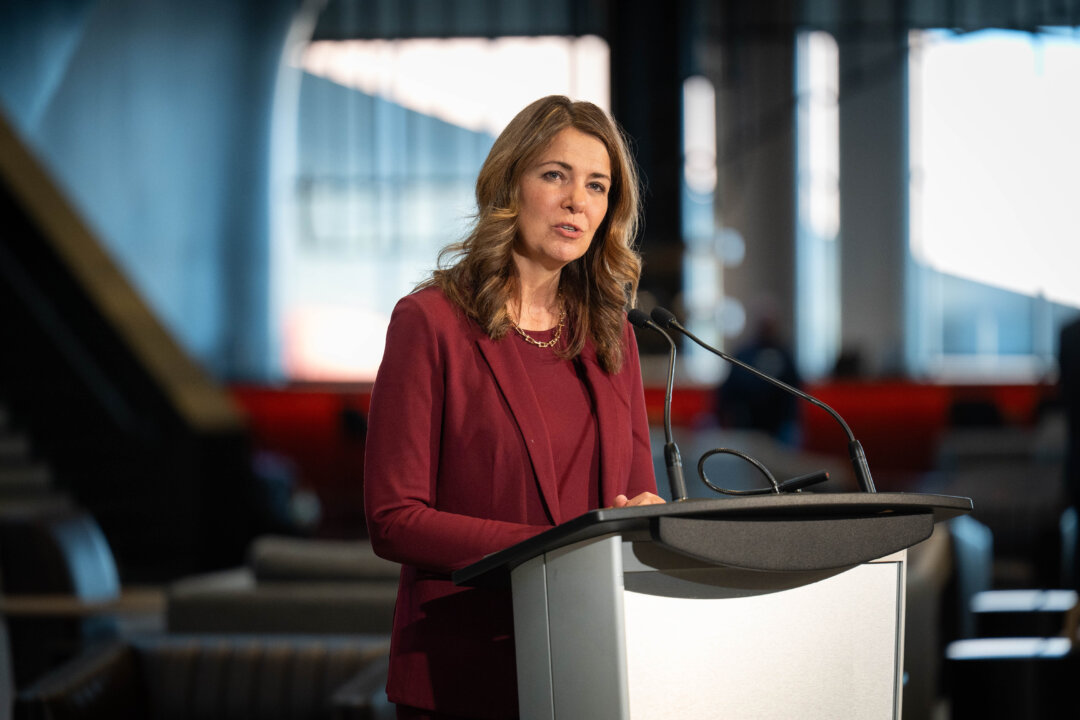
Alberta Premier Danielle Smith takes part in an on-stage chat with journalist Rick Bell at the Canada Strong and Free conference in Calgary on Oct. 16, 2026. Carlos Herrera for The Epoch Times
“I said, ‘Well, here’s a little light reading on your way back to Ottawa, and you'll find out why so many others are going to say ‘Yes to the Nine,’” Smith said during an on-stage appearance with journalist Rick Bell.
Smith said she also plans to discuss immigration at the Council of the Federation meeting in December with premiers who she said share concerns over economic migration, affordability, and strain on public services.
Carney said this week while in Alberta that people should reject the other nine questions as well because “we can have diversity in this province, so we take care of each other, and build together.”
Party Unity
Asked how she would maintain unity within her United Conservative Party (UCP) if a majority of voters choose to remain in Canada but some members of the party continue to support separatism, Smith said she expected that sentiment to decline as Alberta made progress in negotiations with Ottawa.
“I think that Albertans are reasonable people if they can see we’re making reasonable progress on the issues that really matter to them,” she told Bell when asked whether she would “purge” separatists from the party. Smith said she believes many of those in the separatist movement only became activated after Liberals again won the last federal election.
“So it’s not like it was a long-term, deep-seated 20 or 30-year aspiration. It was very recent, based on a fear that the next 10 years would be like the last 10 years,” Smith said. “I think that what I have observed in the past, is that as we start addressing the real issues that upset Albertans, that sentiment declines.”
Provincial Alliance
Four constitutional questions on the referendum pertain to letting provinces select and appoint judges to their superior courts rather than Ottawa, abolishing the Canadian Senate, letting provinces opt out of some federal programs to provide their own versions while still getting federal funding, and giving priority to provincial laws over federal laws in areas where their authorities overlap.
Smith admitted that the path to securing support from other provinces for constitutional reforms would be tough, but she said it would be achievable.
The questions require approval from 50 percent of Canada’s population and at least seven provinces as well as the federal Parliament, while abolishing the Senate would require approval of all 10 provinces and the federal Parliament.
“The Senate is the hardest one because we need to have all 10 legislatures,” she said in response to a question from The Epoch Times at a post-speech press conference. “I think that one is probably the least likely to get that level of success. But I think it would be important for us to gauge where other provinces are.”
Smith said she is optimistic about the other constitutional changes going through, citing the number of Canada’s provinces and territories led by conservative governments.
“We’re at a moment in time where we probably could get constitutional change in a way that we haven’t been able to,” Smith said, adding that she plans to bring up the matter with other premiers and work on establishing a coalition.
In terms of what pursuing constitutional change would mean if voters give her a mandate, Smith said this would be a different approach from previous constitutional negotiations like the failed 1987 Meech Lake Accords and 1992 Charlottetown Accord.
“I don’t know that having a big constitutional convention where the kitchen sink gets thrown in is going to be very meaningful,” Smith said. “But if we can identify some of these core issues that we can agree on together, and I think we can make some change.”









 English (US) ·
  Turkish (TR) ·