

Thomas DiNanno, U.S. Undersecretary of State for Arms Control and International Security, speaks after the first three U.S.-made F-35 aircraft entered into service with the Polish Air Force on June 12, 2026, at the 32nd Tactical Air Base in Poland. Wojtek Radwanski/AFP
A Russian military satellite exhibiting threatening behavior came “dangerously close” to a commercial satellite without permission, a U.S. official has said, in what specialists have described as a potential first-of-its-kind maneuver.
Undersecretary of State for Arms Control and International Security Thomas DiNanno said in an Oct. 21 post on X that Russia’s COSMOS 2612 behavior was consistent with “on-orbit weapons operations.”
“This violates long-established safety thresholds in low Earth orbit,” DiNanno said.
“The United States will continue to secure and defend American vital national security interests in, from, and to space.”
DiNanno made the statement after the United States revealed COSMOS 2612’s maneuver at the First Committee of the 81st session of the U.N. General Assembly on Wednesday.
The U.S. representative to the committee said that the decision to conduct these activities last weekend was “deliberately reckless,” and that the United States believed these maneuvers “are being conducted in an unprofessional manner and do not reflect the behavior of a responsible spacefaring nation.”
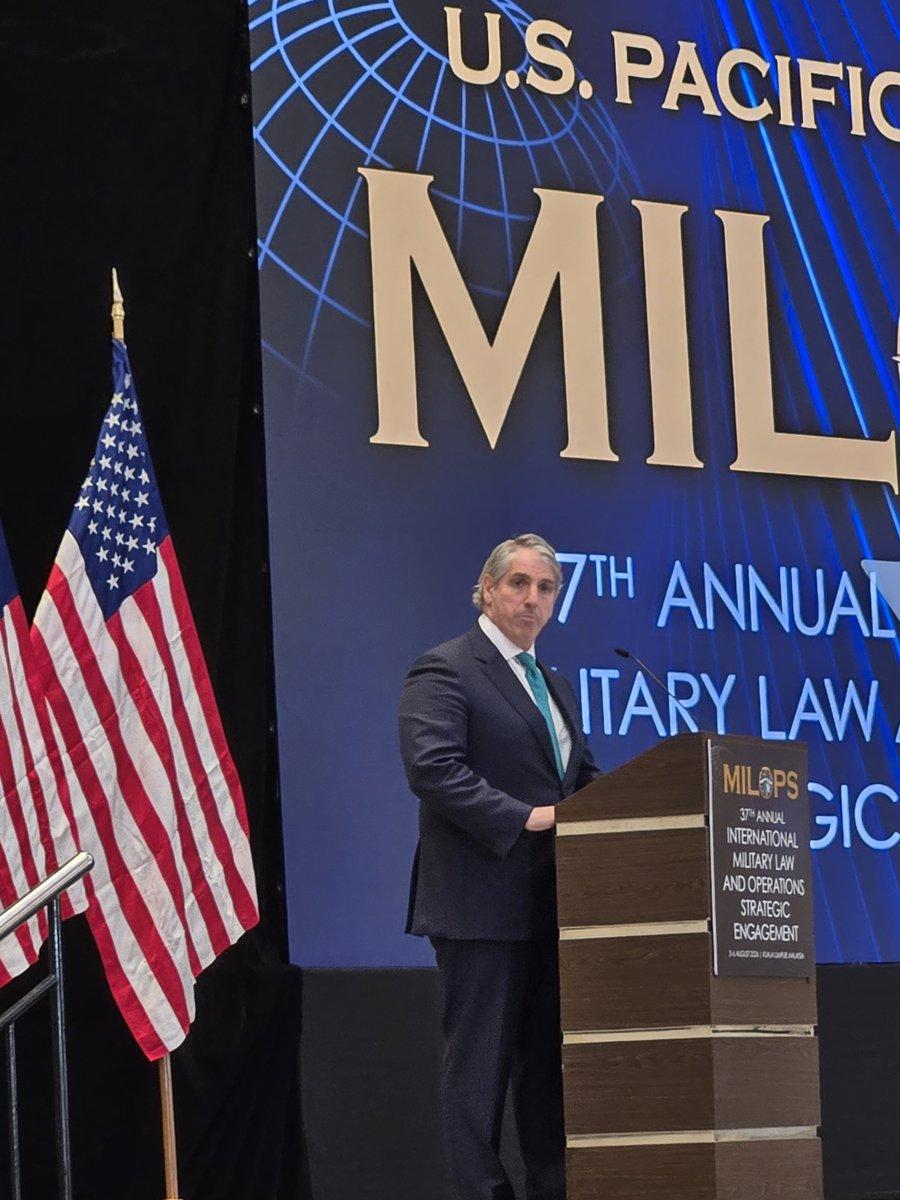
Undersecretary of State for Arms Control and International Security Thomas DiNanno speaks at the 37th annual International Military Law and Operations Conference in Kuala Lumpur, Malaysia, on Aug. 3, 2026. Courtesy of Thomas DiNanno
Marco Langbroek, a satellite-tracking specialist at Delft University of Technology, analyzed the orbits of the U.S.-registered ICEYE-X36 and Russia’s COSMOS 2612, which he said came within as little as a few hundred yards of each other, or possibly closer.
Writing on his blog, Langbroek said that when he began tracking the satellites, he was skeptical that COSMOS 2612 was targeting ICEYE-X36, with the similarity in orbit plane possibly being accidental.
However, he said that after continued tracking for a number of weeks, he determined that a series of the Russian satellite’s maneuvers “were clearly designed to bring KOSMOS 2612 close to ICEYE-X36 and synchronise orbital altitude, eccentricity and orbital period.”
Astronomer Jonathan McDowell said in an Oct. 17 post on X that, to his knowledge, this is the first low-Earth orbit rendezvous of two active satellites where the owner of one of those satellites did not approve.
Russia Rejects Accusation
Russia rejected the claims, with Kirill Vorontsov, deputy director of the Russian Foreign Ministry’s Department for Non-Proliferation and Arms Control, calling them “unfounded and baseless.”
“These absurd allegations have no basis in reality and are part of a propaganda campaign by Western countries aimed at discrediting Russia’s space activities and its initiatives to prevent an arms race in outer space,” Vorontsov said, according to Russian state-run news agency TASS.
He said Russia’s efforts to explore and develop outer space are for peaceful purposes, pose no threat to other nations, and are conducted in accordance with international law.
The Center for Strategic and International Studies (CSIS) said in an Oct. 15 blog post that “Russian counterspace activity in the vicinity of Western satellites should be assessed within the context of aggressive Russian gray zone activities targeting U.S. and European interests.”
CSIS said that maneuvering a satellite in low-Earth orbit with another satellite in the same plane is unusual and not part of standard missions.
Such proximity could be benign, such as removing debris or servicing. But it may also indicate the intention to deploy a weapon or launch a hostile grappling operation, it said.
“The concern arises, then, that a potentially hostile satellite could project kinetic or non-kinetic energy on a target satellite,” the center said.






 English (US) ·
 Turkish (TR) ·
