
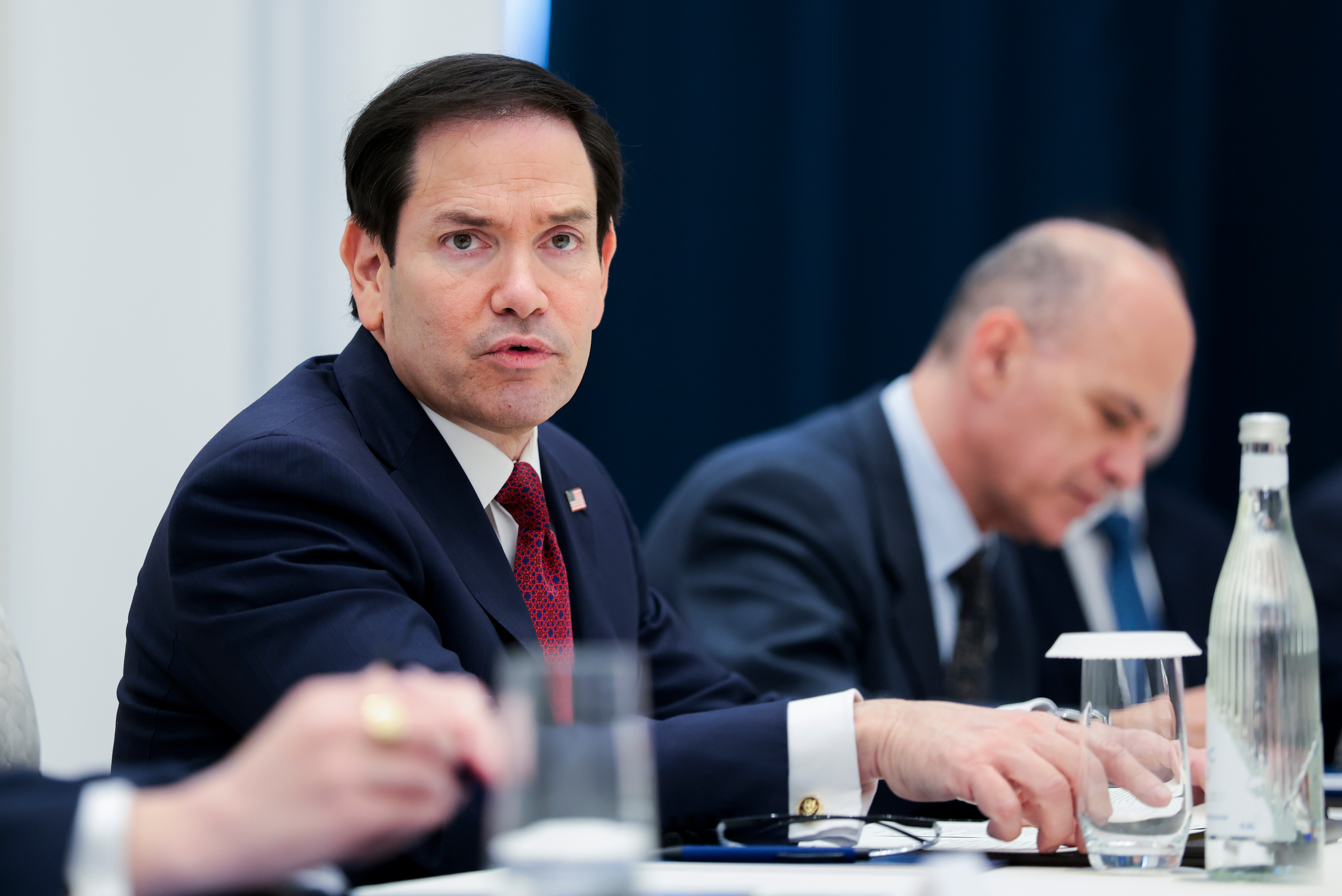
Secretary of State Marco Rubio arrived in India on Tuesday, as the two countries seek to finalize a trade deal, days after President Donald Trump waived tariffs targeting major buyers of Russian oil.
During his two-day visit to the western cities of Mumbai and Jamnagar, Rubio is set to meet Foreign Minister S. Jaishankar and billionaire Mukesh Ambani, chairman of Reliance Industries, which operates the world’s largest refining complex, in Jamnagar.
Rubio landed in Mumbai, India’s financial capital , on Tuesday, where he will meet Jaishankar later in the day.
On Monday, Rubio said that they are trying to finalize a trade deal with India. “We’re very close to doing that,” he added.
India is one of the world’s largest purchasers of Russian crude.
Trump
postponeda final decision on reinstating sanctions and tariffs on Russian exports and is taking up to 60 days to review the economic impact of the delay, Rubio said on Oct. 17.
Trump on Oct. 16
waivednewly authorized Russia-related sanctions and tariffs, including penalties targeting the five largest buyers of Russian oil and gas.
The law
allowedtariffs of up to 100 percent on goods from those countries and up to 500 percent on Russian imports.
Trump
citednational interest without explaining specifically how the waiver served it. The action followed an agreement to temporarily lift sanctions in exchange for Russian diesel supplies, which Trump said would lower fuel prices.
The waiver
hasno fixed expiration date. It remains effective until Trump or the secretary of state decides that further action is appropriate.
Rubio has said the effort to finalize a trade deal was a factor in the decision to waive those tariffs.
“The problem is these sanctions were not just sanctions on Russia. They include tariffs on a number of countries, India, for example, and others,” Rubio said on Sunday.
“And so I think the President wants to take the 60-day period of time to sort of analyze what imposing both sanctions and tariffs will mean to the global economy and even to the U.S. economy.
“You’ve got countries like India, for example, that have voluntarily diversified their energy portfolio, but are still getting a substantial amount of energy from Russia because it’s hard to pivot from one day to the next.
“But they’re also an important ally and partner of the United States.”
In Uzbekistan on Oct. 19, responding to a reporter asking whether countries could continue purchasing Russian oil and gas following the U.S. decision to waive sanctions, Rubio said that “every country has a complex set of factors that they have to take into account.”
“Geography is real. For some countries it’s very difficult to acquire energy from alternative sources. That’s not an excuse, but all of that has to be balanced when you make foreign policy,” he said.
India imported 4.5 million barrels of crude oil and condensate per day in 2023, making it the world’s second-largest net importer, according to a 2023 report by the U.S. Energy Information Administration, with Russia accounting for about 39 percent of those imports.
Rubio’s India trip follows his
meetingon Oct. 19 with leaders from five Muslim-majority Central Asian countries—all former Soviet states—to build economic and security ties in the region.
The C5+1 diplomatic forum, which brings the United States together with top officials from Uzbekistan, Kazakhstan, Kyrgyzstan, Tajikistan, and Turkmenistan, took place in Samarkand, Uzbekistan’s second-largest city.
Washington has characterized the resource-rich Central Asia region, which lies between China, Russia, and Iran, as worthy of more attention than it has received from Trump’s predecessors.
Reuters, Rachel Roberts, and Tom Gantert contributed to this report.





 English (US) ·
 Turkish (TR) ·
