

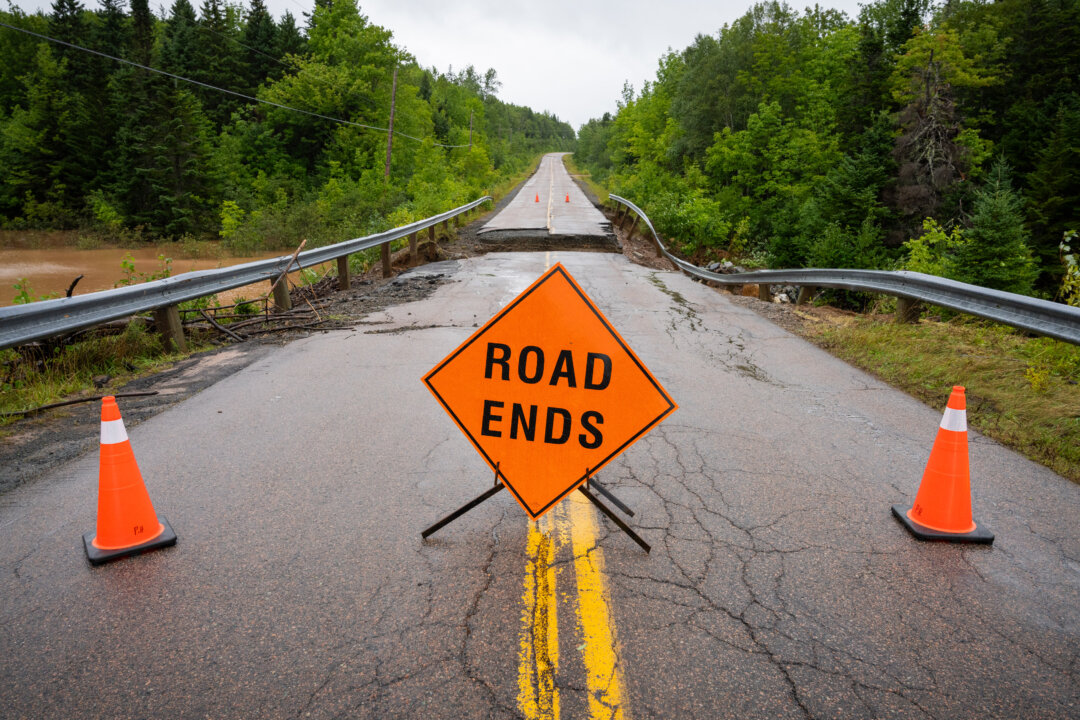
Warning signage is seen in front of a washed-out road near Marble Mountain in Cape Breton, N.S., on Sept. 5, 2026. The Canadian Press/Steve Wadden
A woman has died in flash floods in Cape Breton, Nova Scotia, during a storm that brought over 200 millimetres of rain in two days in some parts of Inverness, Richmond, and Victoria counties.
The 46-year-old woman from Cleveland, a small community in Richmond County, Cape Breton Island, was reported missing at 8:45 a.m. on Sept. 5 and was found dead at approximately 2:30 p.m. the same day, according to a Sept. 6 RCMP news release.
The woman was reported missing after her car was located parked near her home on the far side of a flooded bridge. Police said her body was recovered in the area and her death is not believed to be suspicious.
A local state of emergency, now lifted, had been declared in the three counties around 4:30 p.m. on Sept. 5 due to severe flooding and widespread damage. Multiple roads were closed and conditions were reported as dangerous at the time.
An alert issued at 2:28 p.m. that day advised people to stay off the roads unless travel was essential for health, safety, or emergency purposes. It asked residents to limit travel to help protect public safety, support emergency response efforts, and allow damage assessments to proceed, and to avoid driving through floodwaters or around barricades.
Those in affected areas were advised to dial 511 for updates on road closures.
The province has a 511 Nova Scotia website for travellers that provides a real-time traffic map and live updates of road conditions as well as other information including weather, road closures, construction, major incidents, bridge restrictions, and availability of ferry services.
Separately, Nova Scotia Power has a website that provides a map of live updates on power outages. As of 6:40 p.m. local time on Sept. 6, there were 20 active outages and 129 customers affected, according to the website, with most of them concentrated in Inverness and Richmond counties.
Premier Tim Houston issued a statement on Sept. 6 expressing condolences to the family of the deceased woman.
“Today Nova Scotians are mourning the loss of a woman who died during the flooding in our province. My thoughts are with her loved ones and everyone who is grieving this tragic loss,” he wrote.
Houston also thanked the first responders, emergency workers, volunteers, and members of municipal teams who are working to support communities affected by the flooding.
“To everyone in Nova Scotia, please continue to take care of yourselves and each other and follow the advice of local authorities,” the premier wrote, while urging people to stay off the roads while the weather is bad.
Cape Breton Island’s four counties are classified as being at a medium level for coastal flood hazard, meaning there is more than a 20 percent chance of potentially damaging coastal flood waves occurring in the next 10 years.
Neighbouring Guysborough and Halifax counties are categorized as high hazard level for coastal flooding events.







 English (US) ·
  Turkish (TR) ·