
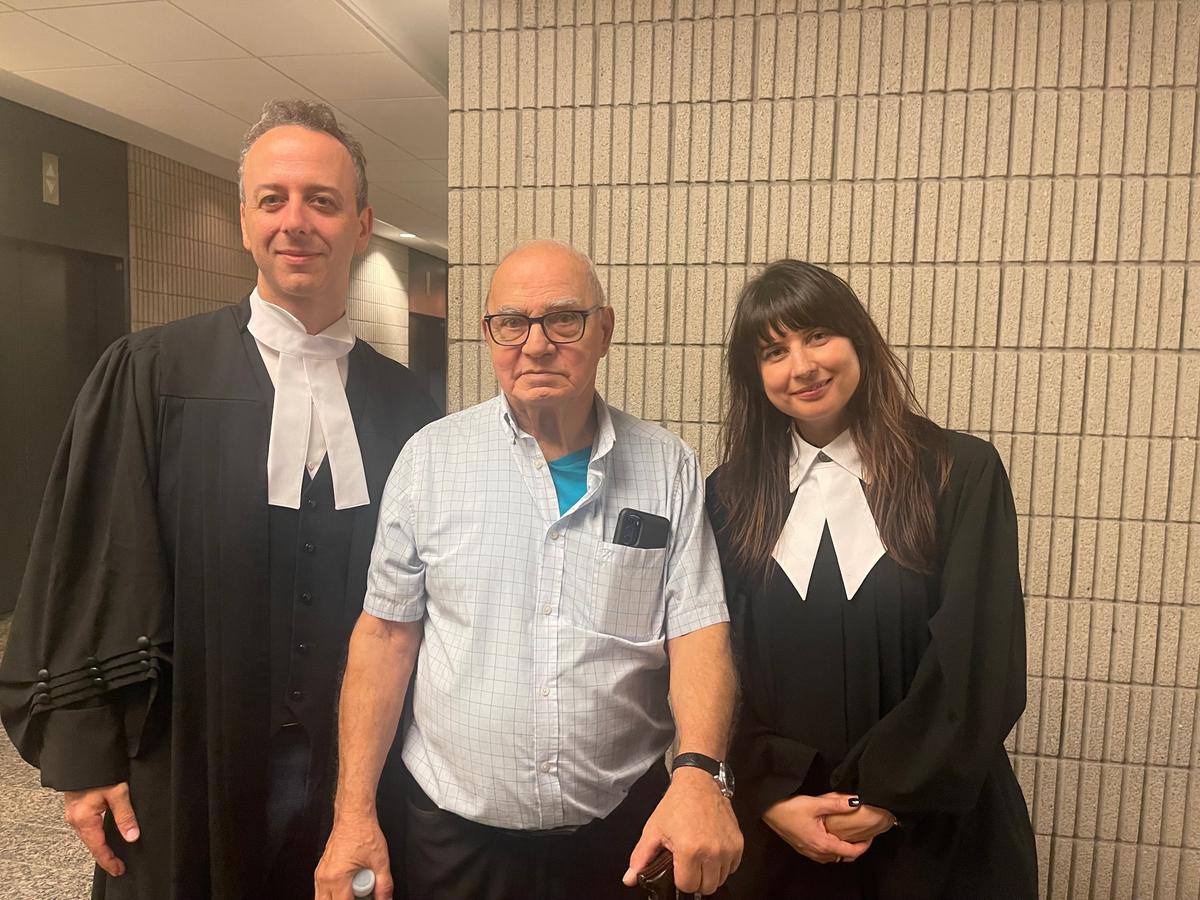
Claude Paquin is flanked by lawyers Nicholas St-Jacques (L) and Julie Harinen (R) at the Montreal courthouse, on Nov.6, 2024, after a judge overturned his conviction in connection with the 1978 murder of two people. The Canadian Press/HO-Julie Harinen
A Quebec man who was acquitted in 2024 of a decades-old double murder has settled a lawsuit with Montreal and the provincial government.
Claude Paquin launched the Superior Court civil suit last year, alleging that police and justice system representatives knew for decades that his 1983 murder conviction was based on false evidence.
Paquin became a free man in 2024 after Quebec’s Crown prosecutor’s office declined to try him for a second time for the 1978 murders of Ronald Bourgouin and Sylvie Revah.
He served 18 years in detention and more than 23 years on parole under strict conditions before being liberated after the federal justice minister ordered a new trial.
The city and province said in a news release that they hoped the settlement would help Paquin turn the page on a difficult episode of his life.
The amount of the settlement was not disclosed.
“The Plaintiff holds the grim record for the longest unjustified deprivation of liberty ever documented in Quebec,” Paquin’s lawyers argued in court documents. “His story illustrates a Dantean judicial process—a series of grave, gross, and malicious state errors that imprisoned him for the better part of his adult life within an institutional grinder that was crushing, irreversible, and inescapable.”
The lawsuit notes that Paquin was 81 years old when he was acquitted, and therefore spent more than half his life deprived of freedom.
A lawyer for Projet Innocence Québec told The Canadian Press in 2024 that Paquin was acquitted based on evidence not presented at his trial, including that the informant who served as the main witness against Paquin changed his story and received money and favours in return for testimony.
The lawyer said there were also statements from another witness who testified Paquin was not involved, and questions about the handling of the crime scene.
The federal justice department ordered a new trial in 2024, concluding that a miscarriage of justice likely occurred.
“This determination is a result of the identification of new and significant information that was not submitted to the courts at the time of Mr. Paquin’s trial or appeal, calling into question the overall fairness of the process,” the department wrote at the time.
The lawsuit claims that the key informant against Paquin, Bernard Provençal, later admitted to having lied.
“Ultimately—and too late—the (Quebec Crown)’s key witness in the plaintiff’s case, the informant Provençal, finally admitted to having perjured himself in order to falsely implicate the plaintiff in a conspiracy with (Montreal police) officers, declaring that he himself was the person truly responsible for the offence,” read the lawsuit.
Paquin’s lawsuit says that for decades, police and prosecutors had enough evidence to secure his release but didn’t come forward.
“Behind bars, he lost everything: his son, his freedom, his years, his identity,” the lawsuit reads. “For 40 years, he endured imprisonment, violence, and humiliation, tirelessly refusing to confess to a crime he did not commit—at the cost of his very freedom.”
Because the lawsuit was settled, its claims were not tested in court, and the parties said they would not make further comment.








 English (US) ·
  Turkish (TR) ·