
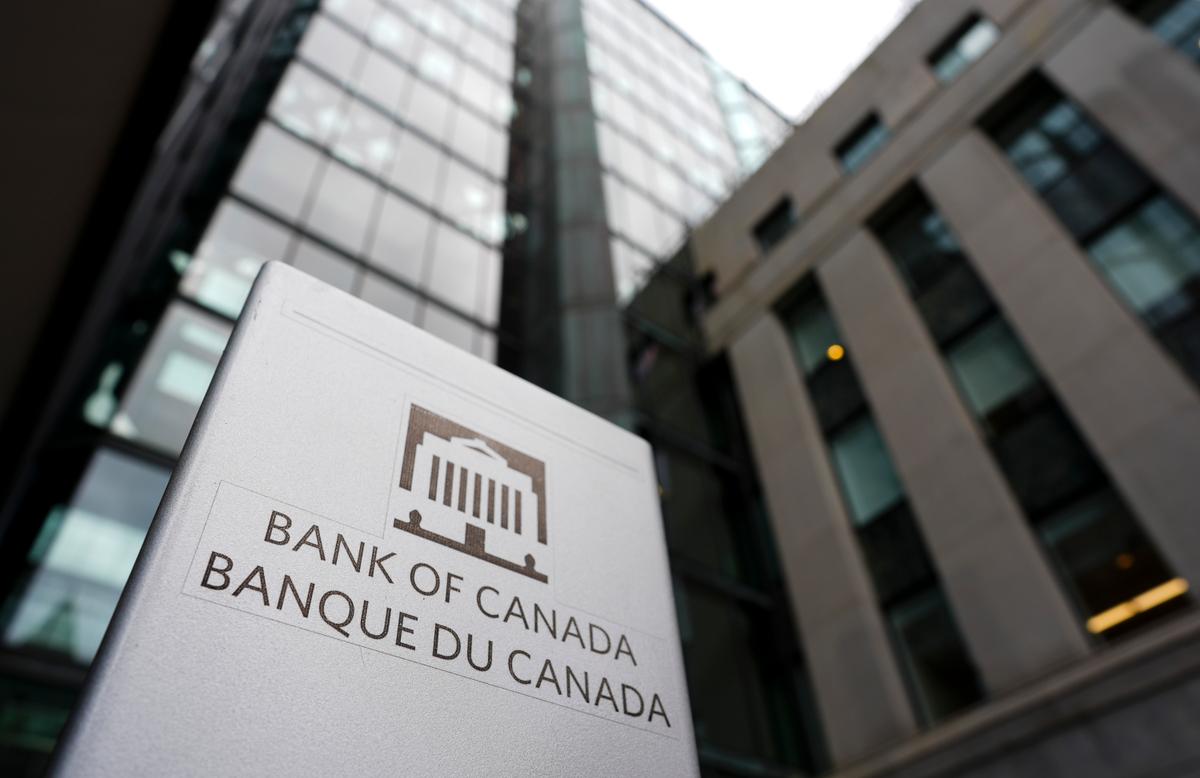
The Bank of Canada building is pictured in Ottawa on April 28, 2026. The Canadian Press/Sean Kilpatrick
Concerns that worsening trade tensions with the United States could weaken Canadian consumer and business confidence factored into the Bank of Canada’s decision this month to hold its benchmark rate at 2.25 percent, newly released documents show.
The central bank published a summary of the deliberations that led it to keep its benchmark interest rate unchanged on Sept. 2, rather than raising or lowering it. The decision marked the seventh consecutive hold and was widely expected by economists.
The Bank’s Governing Council began its policy meetings on Aug. 25, three days after the United States implemented 50 percent tariffs on approximately $28 billion worth of Canadian goods.
The Aug. 22 decision by the White House precipitated a chain reaction of retaliatory measures after the central bank’s rate decision, including reciprocal dollar-for-dollar tariffs from Canada on Sept. 8 and upcoming import restrictions announced by the United States later that same day.
Central bank officials concluded at the time the Aug. 22 tariffs would have a significant impact on certain sectors, but that the broader economic consequences would be limited, the report said.
It said the heightened trade uncertainty could dampen consumer spending, corporate capital investments, and employment growth across the economy, especially if the conflict intensified.
The members also agreed the deterioration in trade negotiations, implementation of new tariffs, and threats of additional trade measures contributed to heightened uncertainty about growth prospects.
“While the government’s fiscal response and businesses’ ongoing efforts to adapt to tariffs and trade uncertainty should help mitigate some of the impact, members agreed that the latest developments made the sustainability of that recovery more uncertain,” the deliberations read.
The central bank didn’t consider Canada’s counter-tariffs to be a significant inflationary concern, however. The reciprocal duties targeted intermediate materials such as steel and products that had Canadian substitutes, meaning “the impact on inflation would likely be muted and spread out over time,” the deliberations said.
Members noted that although headline inflation had remained near the top of the 1 to 3 percent range since April, consumer price index (CPI) inflation excluding gasoline stood at 2.2 percent while core inflation hovered at approximately 2 percent. There has also been minimal evidence so far to suggest that increased gasoline prices were translating into widespread price increases for other goods and services, the summary said.
The Bank of Canada indicated that it is monitoring elevated energy costs tied to the conflict in the Middle East, and discussed the possible need to modify the policy rate during subsequent meetings should inflationary pressures extend beyond fuel consumption.
There was a consensus by the Bank’s council during the meeting that all future rate decisions would be guided by the Bank’s inflation forecast and the risks around it. It said any weakness in growth will be factored into the forecast for inflation, as will the impact of developments in energy prices.
The bank will update its economic and inflation forecasts at its upcoming interest rate decision scheduled for Oct. 28.
The upcoming October interest rate announcement will mark one year since the central bank’s last policy interest rate adjustment when it lowered its benchmark target rate by 0.25 percentage points to the current 2.25 percent.









 English (US) ·
  Turkish (TR) ·