
Less than a year before the 2026 U.S. midterm elections, President Donald Trump ordered U.S. forces to join their Israeli counterparts in bombing Iran. It was a decision whose consequences could impact the rest of his time in office.
Since then, polling has shown falling support among the U.S. general public for the war, the president, and his party.
The Epoch Times spoke to 45 prospective voters from five different states about how the Iran conflict and Trump’s other foreign policy actions are influencing their voting decisions. Those surveyed included Republicans, Democrats, independents, and some who aren’t sure where they now stand.
Those who previously voted for Trump were more likely to support Republicans in the midterms. Still, some who were continuing to back the president and his party expressed hopes for the Iran conflict to end soon, and there were signs of growing fissures within the Republican voting base.
Across the political spectrum, many of those surveyed linked the Iran war to higher prices at the pump. They also listed domestic economic concerns among their leading issues going into the midterm elections.
While Republican redistricting wins may have bolstered their chances of retaining the House, Democrats are still expected to take the majority. Polling has also shown Democratic candidates running competitive races for several Republican-held Senate seats, threatening the GOP’s 53–47 Senate majority.
If Democrats win one or both houses of Congress, they could
substantially constrainTrump for the remainder of his term.
War Stokes Affordability Messaging
On the campaign trail, Democratic candidates have criticized their Republican opponents over America’s involvement in a new war in the Middle East. Much of this criticism has tied the armed conflict abroad to rising prices at home.
“A lot of times with economic policies, it’s hard to show cause and effect. But this is an easy one to show,” Democratic political strategist Mally Smith told The Epoch Times. “Before the war, gas was at around $2.50 a gallon, give or take, and now it’s over $4, and then diesel is at a record high.”
Trump cast his decision to go to war as a necessary measure to prevent Iran from obtaining a nuclear weapon. In the months since the war began, much of the fighting has not centered on destroying Iranian nuclear facilities or capturing Iranian nuclear fuel, but on restoring normal traffic flows through the Strait of Hormuz, a critical trade route for oil, natural gas, and fertilizer.
After U.S. and Israeli forces commenced their attacks, Iranian forces began attacking shipping in the strait, snarling traffic and driving up the economic pain associated with the conflict.
While most Americans feel the added cost at the pump, Smith said high diesel and fertilizer prices are particularly worrisome in agriculture-heavy states like Iowa, Kansas, and Nebraska.

A combine offloads in a field outside of Lindsay, Neb., on Oct. 12, 2026. Michael Clements/The Epoch Times
Amid efforts to calm diesel prices, Trump has
waivedsanctions and tariffs on Russian fuel products. At an Oct. 19 campaign rally in Kansas with first-term Republican Sen. Roger Marshall, Trump also announced an
$8 billion fundto provide farmers with targeted economic relief for their fuel costs.
“When the Republicans win, we will pass even more funding for our farmers,” Trump pledged during the rally.
Larry Ward, a conservative political adviser, said Republican candidates should try to flip the script on affordability by hitting Democrats for past opposition to the domestic fossil fuel industry.
“Republicans need to do a better job messaging in terms of the Democrats and the environmentalists shutting down refineries, and not drilling for so many years, and holding up permits,” Ward told The Epoch Times.
Ford O’Connell, another conservative political strategist, offered similar advice for Republicans.
“You’ve got Democrats who are over there talking about affordability when they’re the ones who drove the car into the ditch,” O’Connell said.
Some Republican candidates are simply distancing themselves from the Iran war.
After Maine Democratic Senate candidate Troy Jackson attacked incumbent Republican Sen. Susan Collins over the war during a recent debate, Collins said, “I agree that the president did not have a good plan.” Collins, who is seeking a sixth Senate term, also noted her repeated votes for resolutions to remove U.S. troops from hostilities with Iran.
Republican Mike Rogers, who is hoping to wrest control of a Senate seat in Michigan from Democrats, released a campaign ad in which he linked grocery prices to the Iran conflict.
“We have to bring prices down. The war with Iran needs to end, and end quickly,” Rogers said.

Republican nominee for U.S. Senate Mike Rogers (R) speaks during a televised debate with Democratic nominee for U.S. Senate Abdul El-Sayed at WOOD-TV, in Grand Rapids, Mich., on Oct. 8, 2026. AP Photo/Paul Sancya, Pool
Ward said it’s understandable for some Republicans to break with Trump if it helps them win competitive contests.
“Mike Rogers and Susan Collins, you know, they’re going to do whatever it takes to, you know, to earn votes. And saying the war should end is a perfectly safe and good statement,” Ward told The Epoch Times.
How Voters See the Iran War
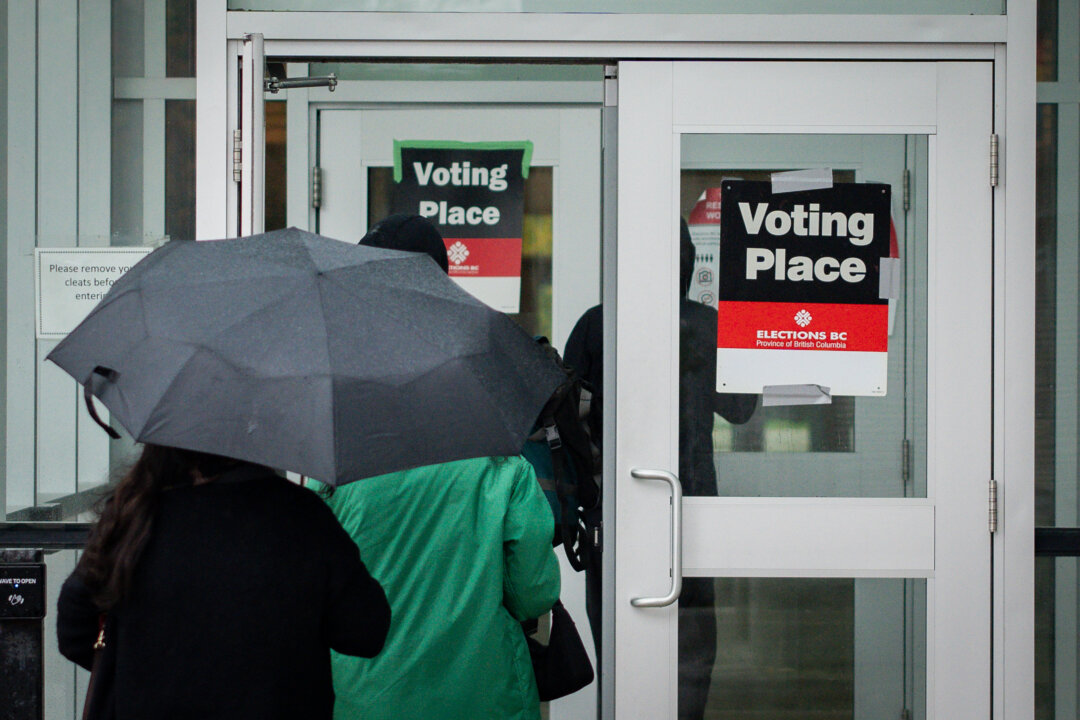
With voting underway, The Epoch Times asked voters how the Iran war is influencing their decision-making at the polls.
Most Republican voters surveyed said they supported Trump’s decisions on Iran and the administration’s position that the conflict was needed to ensure Tehran never obtains a nuclear weapon.
“We had to eliminate the threat of nuclear weapons and a nuclear attack,” John Opacinch, a veteran and retired corrections officer in New York, said.
Many Republican voters cast the conflict as an unfortunate but necessary step to preserve national security and achieve peace in the Middle East.
“I’m not exactly happy that we’re in it, but I trust what Trump is doing,” one male voter told The Epoch Times, “I don’t want a nuclear bomb in the hands of those crazy people.”
Some Republican voters called for Trump to go even harder against Tehran.
“If anything, [Trump] is not doing enough,” Sharon Lesh, a 2024 Trump voter in Pennsylvania, said.
Bill Balisteri, another 2024 Trump voter, likewise said the Trump administration may be handling the war with too much restraint.
“It just buys time for Iran to resist and anti-war sentiment to grow,” Balisteri said. “Iran won’t ever honestly negotiate with [its] current regime.”

A woman holds pictures of Reza Pahlavi and U.S. President Donald Trump as members of the Iranian community celebrate in front of the Federal Building in Los Angeles on Feb. 28, 2026. Apu Gomes/AFP via Getty Images
Other Republican voters said they want the war to end soon. Some said Trump’s foreign policy has led them to reconsider their support for Republicans.
“I think we should end the war and bring real stability to that region,” said Andrew, a 55-year-old who voted for Trump in 2024 but who says he now feels less supportive.
Trump has adopted non-interventionist rhetoric at various points throughout his political career. At multiple points on the 2024 campaign trail, Trump touted his ability to end existing wars and avoid new ones.
After he won the November 2024 election, Trump said, “I’m not going to start a war; I’m going to stop wars.”
Trump’s subsequent decision to strike Iran has caused some division within his 2024 base.
Conservative political commentator Tucker Carlson has cited the war as among the leading reasons for his falling out with the president. Joe Kent, whom Trump endorsed in two congressional races and appointed to serve as the director of the National Counterterrorism Center, cited the Iran war in his letter of
resignationfrom that post.
While figures like Carlson may represent a section of Trump’s base, Ward said voters are more likely to base their decisions on economic considerations rather than their view of Trump’s anti-war record.
“The Tucker Carlson, Candace Owens … Thomas Massie wing is vehemently anti-war,” Ward told The Epoch Times. “I don’t think the electorate is as anti-war. I think they are anti-high gas prices.”
Still, the war appears to have damaged Trump’s credit with at least some potential Republican voters.
Roy, a Gen Z voter and self-described disaffected conservative, told The Epoch Times he does not plan on voting in the midterm elections and feels Trump betrayed his promise to avoid new wars.
O’Connell said younger voters, who have no recollection of events like the 1979 storming of the U.S. embassy in Tehran and ensuing hostage crisis, have not been as swayed by the Trump administration’s premise that the current military campaign is critical to national security.

People attend Day 1 of the 2026 Republican National Committee (RNC) Midterm Convention in Dallas on Sept. 9, 2026. John Fredricks/The Epoch Times
Those who did not vote for Trump in 2024 were more openly opposed to the war.
Allison Ekrot, a Gen Z voter, described the conflict as “totally evil,” and said it has definitely influenced her vote in the midterms.
Judy Ruthier, a Democratic voter from Westlake, Ohio, said Trump was “putting lives unnecessarily at risk” and “doesn’t care.”
Other voters told The Epoch Times that Trump had broken his promise to avoid entangling the United States in foreign wars.
“What a betrayal of all the voters that voted for Trump,” said Stephen Fitz, a Republican-turned-Democrat in Cleveland. “He said no more wars, and he got in a war.”
Other Foreign Policy Matters
While Iran has dominated foreign policy discussions over the past eight months, voters have Trump’s other foreign policy moves to consider.
Since September 2025, the U.S. military has repeatedly bombed suspected drug-trafficking vessels in the Western Hemisphere.
The overwhelming majority of Trump voters surveyed expressed strong support for the strikes.
Balisteri suggested the action was long overdue, saying, “The drugs kill more people than wars or terrorists in our country.”
Non-Trump voters were more divided on the strikes in the Western Hemisphere. Some called for the United States to stop drug trafficking but to do so without the boat strikes.
Independent voter and Navy veteran Dan Shadrake described the boat strikes as “a war crime.”
“There’s no way those boats are hauling drugs,” he said. “They don’t have the range to get to the United States, so just on the very face of it, that’s just a false flag.”

A screenshot from footage of a boat strike targeting drug trafficking in the Eastern Pacific on April 26, 2026. U.S. Southern Command
Most voters approached by The Epoch Times said they were opposed to that possibility.
“Military actions in other countries are just going to deplete our stockpiles and leave us open for those who want to destroy us,” Rich Bodenstedt, a Trump 2024 voter, said.
Trump has also repeatedly pushed for an end to the war between Russia and Ukraine, placing pressure on both Russian President Vladimir Putin and Ukrainian President Volodymyr Zelenskyy to reach a peace deal.
Some voters said the president’s negotiations with Ukraine and Russia have been less effective than they expected, while others said Trump was not supporting Ukraine enough.
“Neither side will listen,” Michael Paternosh told The Epoch Times. Addressing Trump’s efforts to end the war, he said, “It’s a political stunt and it’s going to keep going till one side gets tired.”






 English (US) ·
 Turkish (TR) ·
