
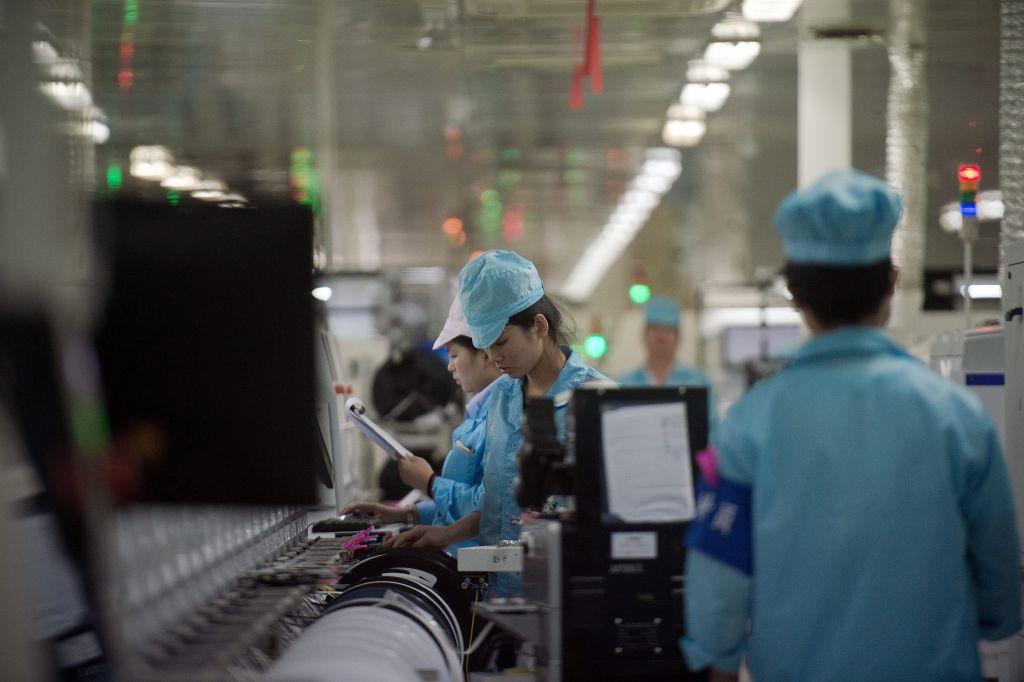
Workers build smartphone chip component circuits at a factory in Dongguan City, Guangdong Province, China, on May 8, 2017. Nicolas Asforui/AFP/Getty Images
Chinese authorities on Sept. 29 announced plans to revoke the “high-tech enterprise” status of 101 companies as industry professionals in China revealed the corruption involved in the regime’s approval process to The Epoch Times.
In the notice, the Guangdong Provincial Department of Science and Technology announced that following a review, 101 companies in the province failed to meet the criteria for certification, and the department intends to revoke their high-tech status. The announcement included a list of the 101 companies.
The announcement did not specify the amount of funds to be recovered, the years involved, or whether the reviewing personnel who approved the qualifications would be held accountable.
Cheng Liang, an executive at a Guangdong-based company who used a pseudonym out of fear of reprisal, told The Epoch Times that authorities are clamping down heavily on false declarations and fraudulent practices in the certification process for high-tech enterprises.
“In the past, many enterprises used third-party intermediaries to ‘package’ themselves—falsifying R&D expense records, fabricating lists of technical personnel, and making false claims about intellectual property rights—all to fraudulently obtain tax incentives for high-tech enterprises,” he said.
“Now, however, there is a severe shortage of funding, and the system cannot support so many companies. Consequently, auditing and restitution are underway.”
A high-tech enterprise certification determines whether a company can access tax breaks and related subsidies, said Yan Fei, a businessman based in Huai’an in Jiangsu Province who used a pseudonym out of fear of reprisal.
“Therefore, many business owners go to great lengths—even pulling strings—to secure these benefits,” he told The Epoch Times. “Having high-tech enterprise status means gaining an advantage: Costs drop, competitiveness rises, and rivals can’t beat you. It’s the same with export tax rebates—foreign companies can’t possibly compete with Chinese firms. Domestic companies are competing for state subsidies, not on the basis of product quality.”
Lei, a commentator who follows Guangdong’s economy and only gave his surname out of fear of reprisal, told The Epoch Times that the CCP allocates resources through administrative approvals, and “since local governments treat the number of high-tech enterprises as a performance metric for officials, companies end up focusing on the pursuit of qualifications and subsidies.”

Technicians work on chip processing equipment at a semiconductor plant in Suqian, in eastern China's Jiangsu province on Oct. 20, 2025. STR/AFP via Getty Images
“Many companies engage in bribery of officials. Whoever is granted ‘high-tech enterprise’ status pays the official who granted it,” Lei said. “It’s not that the CCP has only just discovered this issue—they’ve known about it all along but chose not to investigate because there was money to be shared. Now, however, the state treasury is empty—they’re practically down to their last penny—so they are moving to claw back those tax breaks.”
Authorities must not only claw back the funds but also investigate whether the governmental departments responsible for review, recommendation, and certification were negligent or involved in the illicit transfer of benefits, Lei said.
The Guangdong authorities’ move comes as China has launched an aggressive, retroactive global tax campaign targeting the overseas assets and capital gains of Chinese citizens dating to 2000. Chinese residents will have to pay a 20 percent tax on income derived from transferring assets into offshore trusts, as well as income generated during the lifetime of such trusts, the Chinese regime’s Ministry of Finance and the State Taxation Administration jointly announced in July. The tax scrutiny is tightening as the regime’s coffers are drying up amid a sluggish economy and mounting government debts, according to analysts.
Xiao Bin contributed to this report.







 English (US) ·
  Turkish (TR) ·