
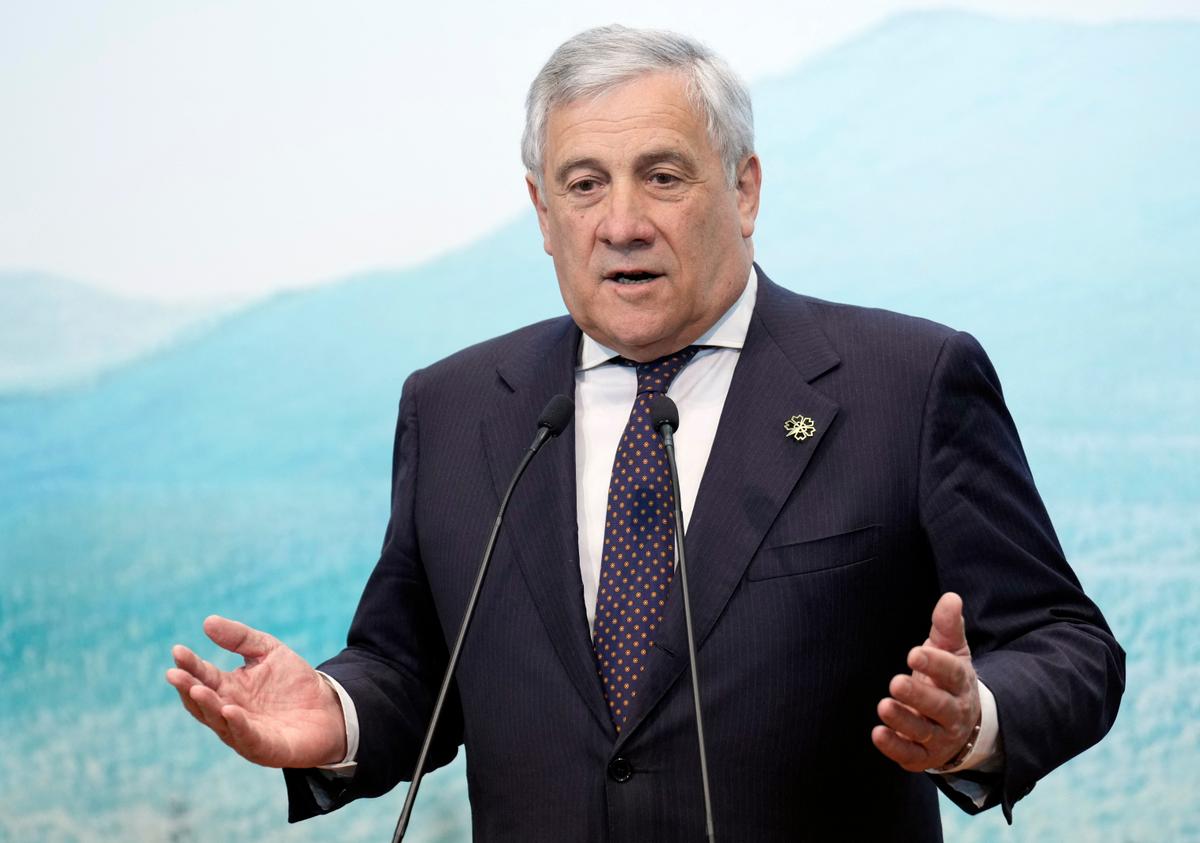
Italian Foreign Minister Antonio Tajani addresses a press conference at the end of a G7 foreign ministers' meeting at Karuizawa Prince Hotel in Karuizawa, Nagano prefecture, Japan, on April 18, 2023. Franck Robichon/AFP via Getty Images
The G7 meeting of foreign ministers will discuss recent cyberattacks, Italian Foreign Minister Antonio Tajani said after hackers leaked his personal data on the dark web.
Tajani told a briefing at his ministry on Nov. 8 that French Foreign Minister Jean-Noël Barrot had accepted his proposal to put the issue on the agenda, “so tomorrow and the day after tomorrow we will be discussing it.”
The G7 (Group of 7) is an informal forum consisting of Canada, France, Germany, Italy, Japan, the UK, and the United States, with representatives from the European Union also in attendance. Member states take on the presidency on a rotating basis, and France currently holds that seat. It will be holding a meeting of foreign ministers in Paris on Nov. 9 and Nov. 10.
Tajani confirmed the agenda item a day after his personal information had been hacked by what he said were pro-Russian actors.
The minister did not blame the Russian government directly.
“I said the hackers are pro-Russian,” Tajani said. “I did not say that the Russian government is responsible. If I had proof of Russian government involvement, I would say so.”
Russia has not commented on the incident, and consistently denies any involvement in cyberattacks, hacking operations abroad, or any other hybrid warfare.
Europe has seen cyberattacks in recent months, including against supermarkets across Europe and a French blood bank this past week.
Posting on the Dark Web
In a Nov. 7 post on X, Tajani said that cybercriminals had posted his personal data on the dark web.
The dark web is a part of the internet whose content is held in anonymous subsections and where a user needs specific configurations and other requirements to access it. Although it can be used for legitimate purposes, it is also used by criminals.
Tajani said that hackers were also targeting his family, and that the criminals were willing to pay for further details about them.
The minister said that Italy’s pro-Ukraine position was one of the reasons that he had been targeted.
“Defending the freedom of a sovereign state, taking a clear stand in support of a nation’s democracy and independence, is dangerous for these criminal entities,” he said.
He also said that the criminals were reacting to recent cybersecurity measures that his Ministry of Foreign Affairs had established, citing the department’s “cyber directorate,” which he said is used to protect against cyberattacks.
“I will continue working to defend my ministry and Italy, and I will keep strengthening ties and cooperation with our allies so that we can protect ourselves together,” Tajani said.
AI-Powered Cyberattacks
Concerns over cyberattacks have been on the rise in recent years, particularly with the prospect of them being powered by artificial intelligence (AI).
Last month, G7 finance leaders agreed to hold exercises to simulate AI-powered cyberattacks on banks to develop new ways of protecting strategic systems from online risks.
The exercises would involve G7 finance ministries and central banks, but could also include private financial institutions, a Japanese finance ministry official said on Oct. 15 on the sidelines of the International Monetary Fund’s annual gathering in Bangkok.
The exercises will test how financial authorities can respond to AI-driven cyberattacks, the official said.
Reuters contributed to this report.




 English (US) ·
 Turkish (TR) ·
