

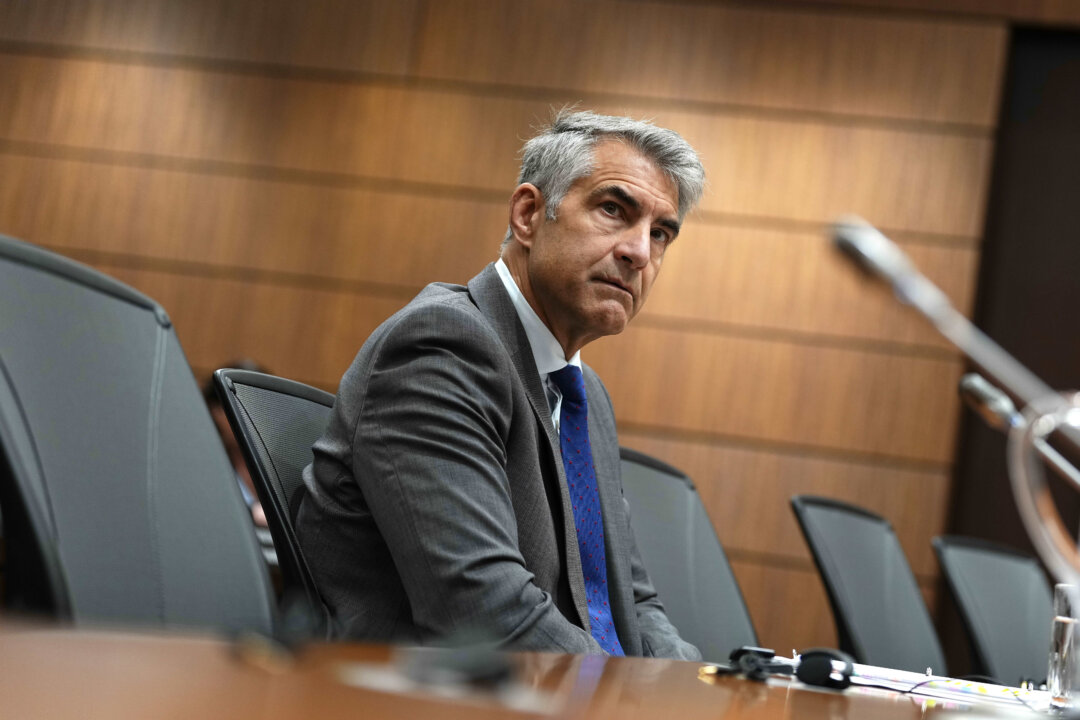
Foreign Influence Transparency Commissioner Anton Boegman prepares to appear before the Standing Committee on Procedure and House Affairs (PROC), studying the implementation of the foreign influence transparency registry, on Parliament Hill in Ottawa, on Oct. 6, 2026. The Canadian Press/Justin Tang
Canada’s foreign influence commissioner says he expects registrations under the new registry to increase in the coming months, after a Conservative MP said fewer than 1 percent of the 2,422 registrations estimated by Public Safety Canada have been made so far.
“As the information becomes better known, I expect that as individuals understand more about the registry, that the numbers of registrants will increase,” Commissioner Anton Boegman told the House of Commons Standing Committee on Procedure and House Affairs on Oct. 6.
The foreign influence registry, which officially launched on Aug. 4, is intended to allow Canadians to see which individuals or organizations are acting on behalf of foreign states to influence Canada’s political or governmental processes. The registry states that individuals or organizations that enter into arrangements with “foreign principals” may be required to register.
Boegman said in his opening statement before the committee that individuals or organizations that fall within this scope must register with his office within 14 days of entering into an arrangement. If the arrangement existed before Aug. 4, they had until Oct. 3 to submit their registration.
Boegman said he had met with representatives from universities, government relations firms, consular groups, industry associations, and diaspora organizations. He said his office is continuing to receive submissions “as individuals and organizations assess their obligations under the Act.”
Conservative MP Michael Cooper said the registry’s website showed just two listings, which he said signalled that it “doesn’t even begin to scratch the surface of persons and entities who are acting on behalf of a foreign principal.”
Boegman said his office had received more than 30 additional submissions over the weekend and argued that “like many registration deadlines, people leave it to the last minute.”
Cooper noted that Public Safety Canada had estimated that 2,422 persons and entities—including 872 individuals and 1,550 businesses—could be subject to registration.
“Shouldn’t alarm bells be going off with a compliance rate of 1 percent?” Cooper said.
Boegman said the estimates were for “a range of registrations that may be required over the course of a registration period, not instantaneously, not all at once.” He said the registry had not yet fully reviewed all the submitted registrations and was not in the process of issuing any notices of violation.
The Foreign Influence Transparency and Accountability Act was passed amid concerns about foreign interference in Canada and established the framework for the public registry. The Foreign Interference Commission was established in September 2023 following reports of extensive meddling by Beijing in Canada’s affairs, and concerns about foreign interference in the 2019 and 2021 federal elections. Its initial report found that foreign interference had occurred in both elections but said it did not alter the overall results.
The foreign influence registry stems from legislation passed in response to the findings of the Foreign Interference Commission, which was launched in 2023 following reports of extensive meddling by Beijing in Canada’s affairs.
In an interim report released on May 3, 2024, the commission found foreign interference likely occurred during the 2019 and 2021 federal elections. In her final report, Commissioner Justice Marie-Josée Hogue concluded the interference did not alter the overall election results, although individual ridings may have been affected.
Privacy Breach
During the committee meeting, Cooper also asked Boegman about a privacy breach involving retired diplomat and prominent China expert Charles Burton. Cooper said that when Burton submitted information to the office, the response was mistakenly sent to a “third party” and disclosed his personal information.
Cooper noted Burton has been targeted by Beijing and was previously told by the Canadian Security Intelligence Service (CSIS) that his communications were being monitored. Burton was also temporarily detained and interrogated by China’s Ministry of State Security in 2018.
“How can other Canadians who want to register, who are the targets of hostile foreign states, have any confidence that your office will properly safeguard their personal information?” Cooper asked.
Boegman said protecting Canadians’ personal information is a “priority” for the office. He said the information disclosed in the breach related to Burton’s registration number and that his personal information had not been compromised.
Boegman later said there had been no other emails sent to third parties in error, but that there had been a second privacy incident.
“We published information on the registry two weeks ago that included some information that should not have been on the registry. We pulled the registration off the register. We examined why that happened,” he said.
Boegman said the information had been improperly displayed on the website because of “some technical limitations on the current registry system,” and that the issue was being addressed. He also acknowledged that a scheduled phone call with Burton to discuss the privacy breach initially could not go ahead because of a technical outage.
“There have been a number of technical issues, as you have highlighted,” Boegman said to Cooper. “Whenever technology is used to facilitate communications, there is a risk that there can be an issue with that.”




 English (US) ·
  Turkish (TR) ·