
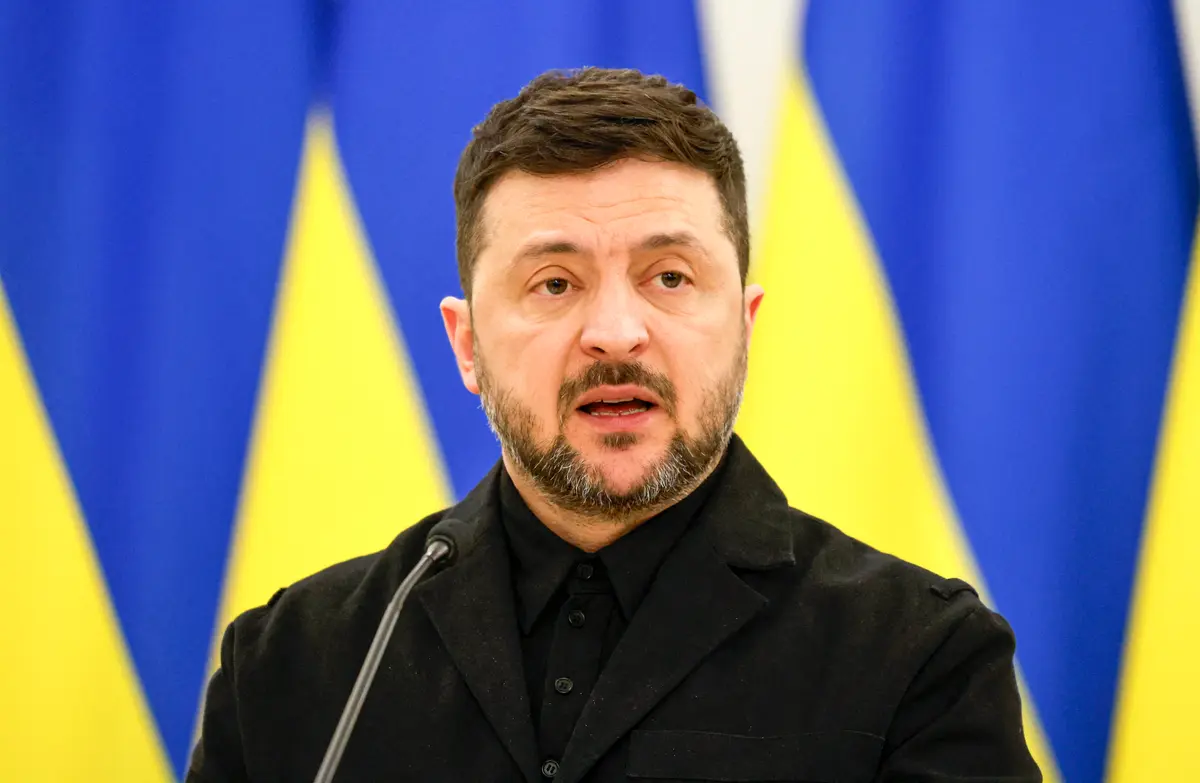
Ukrainian President Volodymyr Zelenskyy in Vilnius, Lithuania, on Jan. 25, 2026. Petras Malukas/AFP via Getty Images
Finnish tech giants Nokia and ICEYE signed a letter of intent with the Ministry of Defense of Ukraine, formalizing a partnership aimed at developing its own sovereign satellite system, Ukrainian President Volodymyr Zelenskyy announced after meeting with Finnish Prime Minister Petteri Orpo on Oct. 22.
“We agreed to make greater use of Finland’s satellite capabilities—this is important for our defense and Ukraine’s resilience,” Zelenskyy said on X. “We reached agreements on this with Nokia and ICEYE.”
The deal with telecommunications company Nokia and ICEYE, which provides satellite communications systems, will focus on supporting Ukraine’s defense capabilities in space, according to a statement from Nokia.
CEO and Co-founder of ICEYE Rafal Modrzewski said Ukraine needs “secure, sovereign and high-performance satellite communications systems that it controls.”
“We have a proven track record of delivering sovereign missions at speed to help build that capability,” Modrzewski said. “ICEYE has proudly supported Ukraine since 2022, and we remain committed to continuing that support today.”
Nokia Defense Chairman Mikko Hautala said that along with Kyiv and ICEYE, the company will explore how sovereign satellite communications can improve the connectivity systems that Ukraine’s military depends on.
Sovereign Satellite Systems
The signing of the letter of intent came after the two Finnish companies announced they would be partnering to develop sovereign broadband low-earth orbit communications systems for governments, which could be used for defense, emergency disaster response, and border security.
ICEYE said in an Oct. 1 statement that satellite communications systems would be owned and controlled by the countries that use them, including the satellites, ground segment, and terminals.
The company said it expects to launch the first of such communications systems into space in 2028.
These systems will provide resilient communications infrastructure which will remain available under demanding conditions, it said, even when terrestrial networks are disrupted or compromised.
Ukraine and Starlink
The Ukrainian military currently relies on SpaceX’s Starlink satellite internet service for its battlefield communications and interceptor drone strikes.
However, on Oct. 14, Ukrainian officials said the country was experiencing
limitationsin its Starlink service, saying it had been blocked on linked devices moving faster than 100 miles an hour, including its fast-moving interceptor drones that Ukraine’s forces use to blunt barrages of Russian explosive one-way attack drones.
Communications problems persist, according to Ukrainian officials,
U.S. President Donald Trump told reporters on Friday that he believes Ukraine’s access to Starlink had been restored, adding that he would speak with SpaceX CEO Elon Musk if that was not the case.
Zelenskyy told ABC on Friday that Starlink was still not functioning properly.
“We are currently not observing any lifting of speed limits on Starlink,” presidential adviser Serhii Beskrestnov wrote on Telegram on Oct 23.
“There are isolated instances where Starlink may travel slightly faster than the speed limit, but this is likely due to the SpaceX algorithm or specific usage conditions.”
Rachel Roberts and Ryan Morgan contributed to this report.










 English (US) ·
 Turkish (TR) ·
