
The European Union (EU) has unveiled plans to boost security in the Arctic that include better threat detection and a hub to monitor undersea cables.
The European Commission said in an Oct. 19 statement that the new Strategy for the Arctic also focuses on protecting northern maritime borders and monitoring shadow fleet vessels.
The EU will work to integrate its infrastructure—including ports, energy infrastructure, and satellite connectivity—into the emerging Arctic transport and trade networks.
As new shipping routes open up due to melting ice, the Arctic and High North have become increasingly important to the United States and Europe, as well as China and Russia. The stakes were raised when Russia invaded Ukraine in 2022, and NATO began expanding its presence in the region.
Unveiling the plans on Oct. 20, European Commission President Ursula von der Leyen said that the Arctic is where the “tectonic plates of geopolitics are colliding,” and represents what she called Europe’s “Northern Neighbourhood.”
Three of the EU’s member states—Sweden, Finland, and Denmark, via its territory, Greenland—are part of the Arctic, and more than half a million EU citizens live in the region.
“So when we see Russia rebuilding its Arctic military footprint, pursuing hybrid strategies against its neighbours, and reshaping the security of the Arctic: it impacts the European Union as a whole,” von der Leyen said.
“When we see that sovereignty, territorial integrity, and the rules that have underpinned stability in the region can no longer be taken for granted, we have to act and change our strategic posture. And, together with like-minded partners, stand up for these values.”
Focus on Arctic
The Commission said that it will establish a Maritime Security Hub for the 27 member states and other regional partners to share information and monitor activities. It will start with an Arctic Cable Hub, which will “monitor, protect and help repair submarine cables in the North Atlantic and Arctic.”
Investments will be made in technologies to detect potential threats to critical infrastructure. The Maritime Security Hub will be further developed to include tracking shadow fleet vessels, as well as illegal fishing and pollution.
European Commission Vice President Kaja Kallas said that “with Russia and China increasing their footprint and ambition, the Arctic has become a front line of global power competition.”
“Our revamped Strategy reflects this new reality and puts security firmly at its core,” she said. “To defend our interests, we are stepping up efforts in surveillance, infrastructure, military mobility, and defence technologies that can withstand the harsh climate.”
Kallas said that access to Arctic sea lanes and the region’s natural resources “is of strategic interest to the EU.”
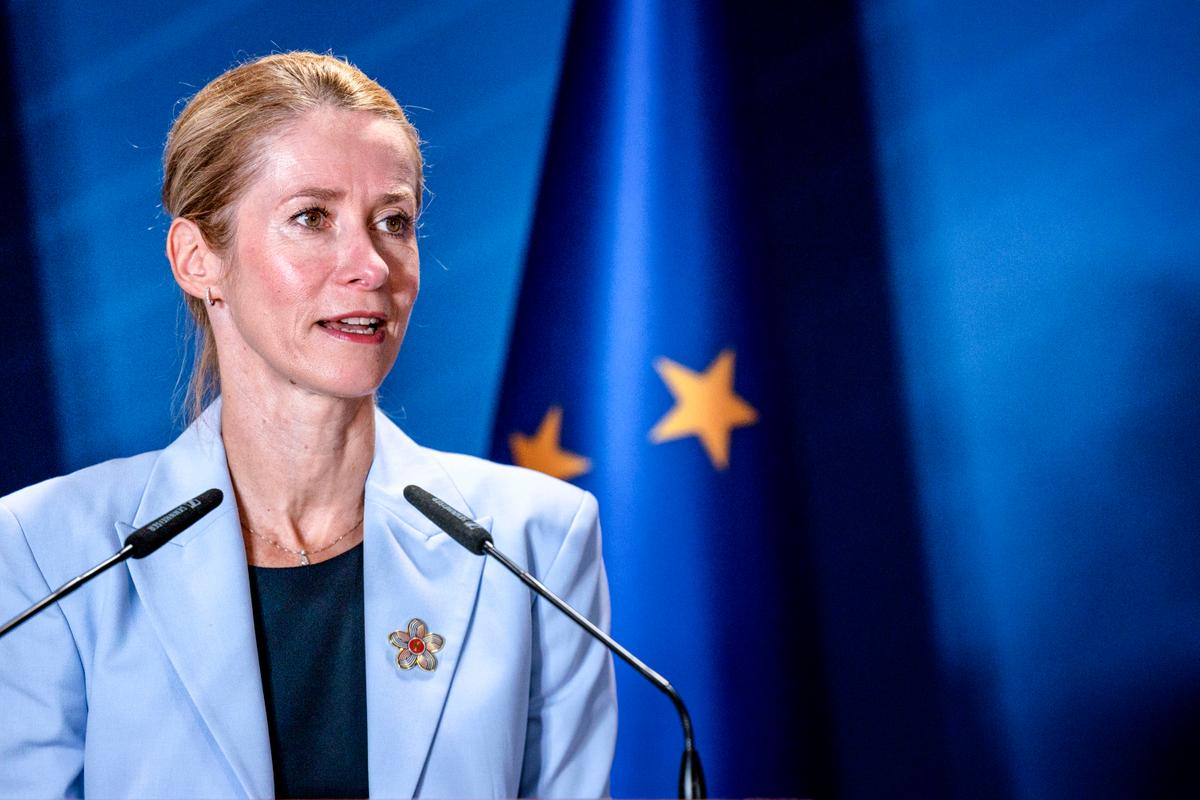
European Commission Vice-President Kaja Kallas in Pasay, Metro Manila, Philippines, on July 24, 2026. Ezra Acayan/Getty Images
The Arctic has become a focus of security concerns in recent months for the United States, particularly the Danish territory of Greenland.
U.S. President Donald Trump had previously said he wanted to annex Greenland, calling it
essentialto securing the region.
NATO has been placing greater emphasis on demonstrating its presence and defensive capabilities in the Arctic region in response to Trump’s security concerns.
Earlier this year, NATO
launchedthe Arctic Sentry military command, amid growing concerns about potential threats posed by regional adversaries—specifically China and Russia.
Then on Sept. 22, Trump
signeda national security agreement with Denmark and Greenland allowing the United States to expand its military presence and control security for the key Arctic territory.
Moscow has said that NATO military activity in the Arctic poses a threat to Russia’s security.
Russian Foreign Minister Sergei Lavrov said on Aug. 31 that such activity increases the “risk of incidents that could trigger an armed confrontation with potentially disastrous consequences.”






 English (US) ·
 Turkish (TR) ·
