
European Commission President Ursula von der Leyen has announced a 200 million-euro ($232 million) boost in European Union funding for Greenland, as well as closer political ties with the Danish Arctic territory, which U.S. President Donald Trump has repeatedly
saidshould be controlled by Washington for security reasons.
“The EU stands in full solidarity with the Kingdom of Denmark and the people of Greenland,” Von der Leyen told a news conference on Monday after signing a declaration with Greenlandic Prime Minister Jens-Frederik Nielsen and Danish Prime Minister Mette Frederiksen.
Von der Leyen said the investment partnership “will create new opportunities and a strong and engaged EU in both Greenland and the Arctic, because Greenland is a strategic ally and a trusted friend.”
She arrived in Greenland’s capital, Nuuk, on Sunday for a two-day visit, seen as a show of solidarity with both the Greenlandic and Danish governments, which have both strongly
rejectedU.S. calls to control the world’s largest island.
Critical Minerals and Renewables
Von der Leyen, who heads the executive body of the EU, laid out investment plans for sectors including critical minerals, satellite communications, and renewable energy in the strategically important island, which is a semi-autonomous territory of the Danish realm.
Nielsen said the island, which is sparsely populated with about 56,000 people of chiefly Inuit descent, wanted to build on its “close friendship and good partnership” with the EU.
Greenland left the EU’s predecessor, the European Economic Community, in 1985, following a referendum three years earlier.
But its people are Danish citizens, which also makes them citizens of the EU, with Denmark part of the 27-nation bloc.
The mineral-rich Arctic island has become of increasing geopolitical importance to the major powers in recent years, with its location between North America and Europe making it a key location for the U.S. ballistic missile defense system as well as placing it on a key North Atlantic shipping route.
‘Tectonic Plates of Geopolitics’
Von der Leyen told the press conference: “The Arctic has become one of the places where the tectonic plates of geopolitics collide. We have a direct stake in what happens here.”
On Sunday, she posted on X after taking a boat trip in a fjord that Greenland’s “stunning landscapes and natural beauty” would remain with her for a long time.
“But so will the visible scars of climate change on the ice sheet,” she wrote, along with a video clip showing glimpses of whales and bits of floating icebergs in the ocean beneath a bright blue sky.
“As the ice melts, a new reality is taking shape. New trade routes, new security risks, new environmental concerns.”

Danish Prime Minister Mette Frederiksen (C), Greenlandic Prime Minister Jens-Frederik Nielsen, and European Commission President Ursula von der Leyen (R) visit Qoornoq, Greenland, on Sept. 6, 2026. Mads Claus Rasmussen/Ritzau Scanpix via AP
Crisis for NATO
Trump reiterated his demands to control Greenland earlier this year, following earlier remarks about the territory during his first term in office.
He said that fellow NATO member Denmark lacked the capability to defend Greenland from Russian and Chinese warships, which he said were stalking the island.
European leaders have stressed that Greenland is part of Denmark, a NATO member, and is covered by the alliance’s mutual defense pact, while pointing out that the United States already has a military presence there under a longstanding defense agreement.
Tensions were diffused after Trump and NATO boss Mark Rutte
agreedin January at the Davos summit that the United States, Denmark, and Greenland would start talks to resolve their differences diplomatically, and that NATO would step up its role in Arctic security.
The trilateral talks have yet to reach an agreement, however, and Trump reiterated at July’s NATO summit in Turkey his position that the United States should control Greenland.
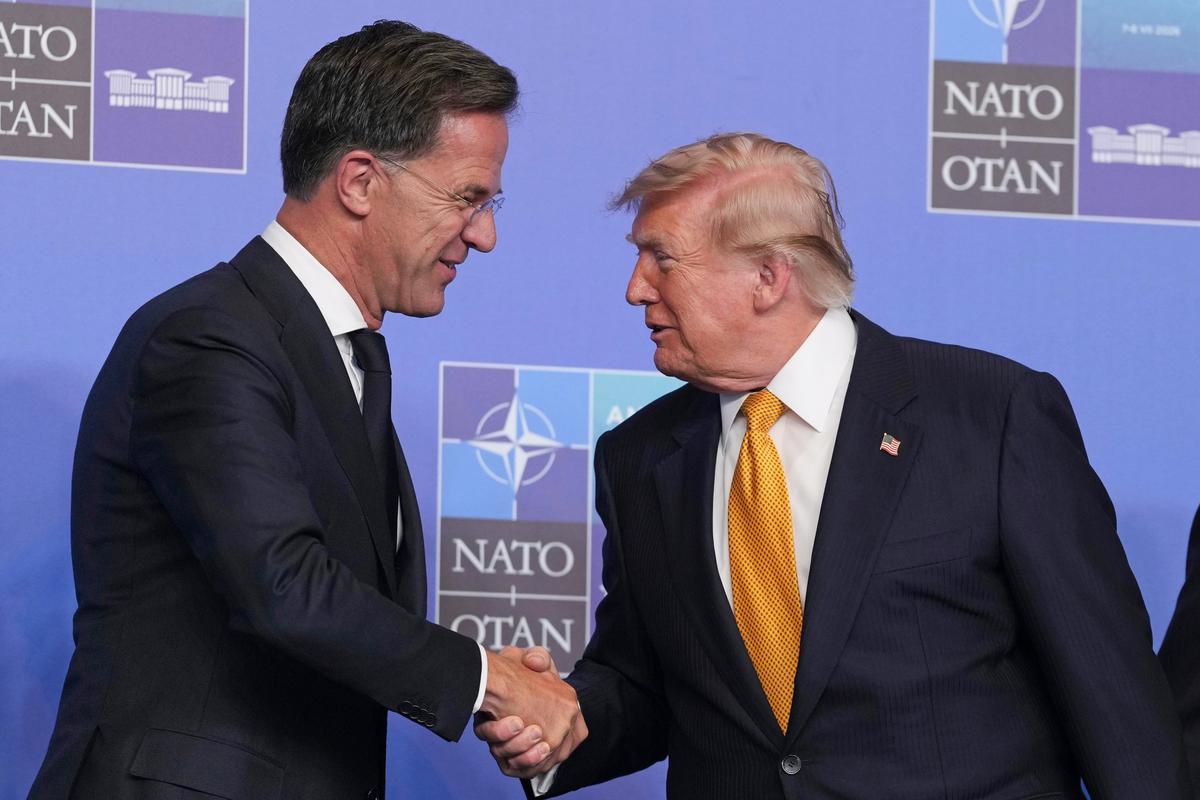
President Donald Trump is greeted by NATO Secretary General Mark Rutte as he arrives for the NATO summit in Ankara, Turkey, on July 8, 2026. Alastair Grant/Getty Images
The package announced by Von der Leyen marks both a significant increase in funding and a broadening of the sectors that will receive EU cash.
The bloc has long provided funding to Greenland, primarily for fishing rights and the island’s education system, with support for these sectors set to continue.
The new package also aims to help fund hydropower systems and the use of critical raw minerals, with money also designated for internet connectivity, better housing, and support for small businesses and sustainable tourism.
Denmark and seven of its European allies
senta small group of military personnel to the island in January, officially to take part in military exercises focused on bolstering Arctic security, but with the effect of showing support for Greenland’s sovereignty as part of the Danish kingdom.
In response, Trump threatened to hit all the countries taking part with fresh tariffs, before backing down after NATO
agreedto a security deal in the Arctic region.
Von der Leyen’s visit took place as 11 NATO countries began military exercises in Greenland on Monday, dubbed Operation Arctic Shield, involving around 400 troops, including some from special forces trained to operate in Arctic conditions.
Reuters contributed to this report.

 English (US) ·
  Turkish (TR) ·