
Egypt has approved military support for Saudi Arabia as Houthi attacks intensify and Saudi Arabia’s regional security partners, Turkey and Pakistan, step up diplomatic and military coordination.
Egyptian lawmakers on Monday authorized Egyptian President Abdel Fattah el-Sisi to take measures to help defend the kingdom, but did not specify what form Egypt’s support would take.
The parliamentary vote was conducted as fighting between U.S. ally Saudi Arabia and Yemen’s Iran-backed Houthis has sharply escalated, ending a U.N.-brokered truce that had largely held since 2022.
A senior Houthi official, Mohammed Ali al-Houthi, condemned Egypt’s decision and urged members of the Mecca defense pact to leave the alliance. He said Egypt, by backing what he called the defense of Saudi Arabia, was effectively declaring war on Yemen.
Egypt has repeatedly condemned attacks by Iran and Iranian-backed groups against Gulf states but has not publicly participated in combat operations during the latest escalation or joined the Mecca Joint Defense Agreement signed in August by Saudi Arabia, Pakistan, and Turkey.
Separated by the Red Sea, Egypt and Saudi Arabia share strategic interests in protecting maritime routes through the Bab al-Mandeb Strait, the Red Sea, and the Suez Canal, waterways that are central to both countries’ economies.
Last month, Sisi and Mohammed bin Salman reaffirmed their commitment to protecting freedom of navigation through the key maritime routes and pledged closer political and security coordination.
Fighting Intensifies
Egypt’s parliamentary approval comes as military operations continue to intensify across Yemen and Saudi Arabia.
Saudi coalition spokesperson Turki Al-Malki said on Tuesday that Saudi air defenses intercepted and destroyed three ballistic missiles and seven drones launched toward the kingdom’s eastern, Riyadh, and southern regions.
On Monday, he said that Saudi forces carried out a large military operation targeting Houthi military infrastructure.
According to Al-Malki, Saudi strikes destroyed five missile storage tunnels, four ballistic missile launchers, a missile depot, and targeted Houthi supply routes, fortifications, personnel, and military equipment across front lines inside Yemen.

A man inspects damage at the site of an airstrike that targeted the Asr district of Yemen's Houthi-held capital Sanaa on Oct. 24, 2026. Mohammed Huwais/AFP via Getty Images
Earlier this month, a Houthi attack on Riyadh’s King Khalid International Airport killed 13 people. Saudi Arabia also shut down its East-West crude oil pipeline in September as a precaution after a drone attack that Riyadh and Baghdad said originated in Iraq.
Houthi spokesperson Yahya Saree said on Monday that Saudi warplanes conducted 119 airstrikes and missile attacks during the previous 24 hours against what he described as civilian sites in Sanaa and the provinces of Al-Jawf, Taiz, Saada, Amran, Ibb, and Lahj.
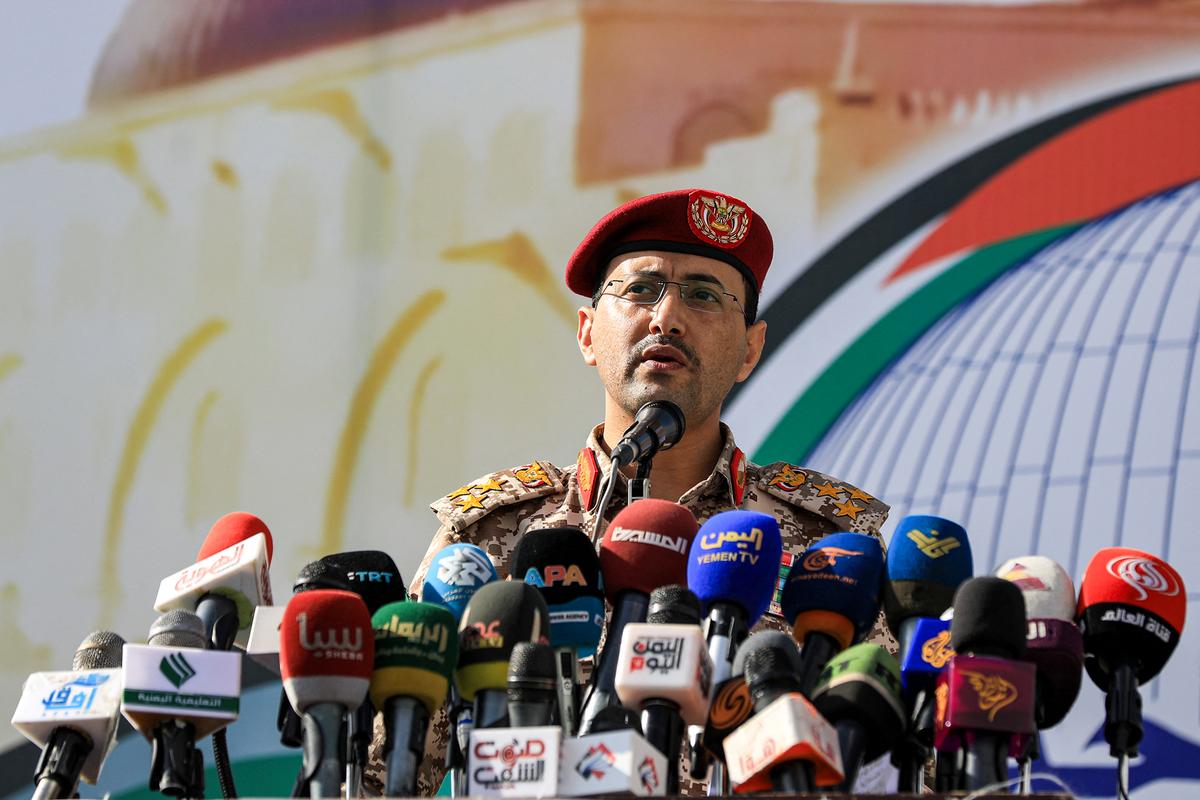
Yahya Saree Qasim, spokesman for Yemen's Houthi terror group, speaks in Sanaa on May 3, 2024. Mohammed Huwais/AFP via Getty Images
In a separate statement on Monday, Saree said the Houthis targeted King Khalid International Airport in Riyadh with a ballistic missile and attacked crude oil pumping stations in eastern and western Saudi Arabia using drones.
The U.S. Embassy in Riyadh on Tuesday reiterated an Oct. 23 security alert from the U.S. State Department, ordering non-emergency U.S. government employees and their families to leave Saudi Arabia because of safety risks.

Vehicles drive along a road in Mecca on Oct. 25, 2026. AFP via Getty Images
The embassy also confirmed that King Khalid International Airport in Riyadh partially reopened on Oct. 23 for domestic flights and some international flights operated by national carriers.
Pakistan, Turkey Continue Defense Coordination
Egypt’s parliamentary approval on Monday coincided with continued military coordination among the three members of the Mecca agreement.
Pakistan’s military confirmed that army chief Field Marshal Asim Munir met Iranian officials in Tehran on Monday, according to a Pakistan Armed Forces spokesperson.
The diplomatic activity follows an emergency meeting of the pact’s members in Riyadh earlier this month, when Saudi Arabia, Pakistan, and Turkey agreed to ensure the rapid deployment of military forces and capabilities inside Saudi Arabia.
Pakistan approved the defense agreement last week, while Turkey’s parliament is continuing its ratification process.
Egypt is not a member of the Mecca agreement, which commits its members to closer military cooperation and includes a collective defense clause treating an armed attack against one member as an attack against all.
Reuters contributed to this report.








 English (US) ·
 Turkish (TR) ·
