
Congolese health officials say the number of confirmed Ebola cases has surpassed 10,000, with nearly 4,900 people having died since the start of the country’s latest outbreak.
Congo’s Ministry of Public Health in an Oct. 26 update reported 96 new confirmed cases and 46 deaths over the previous 24 hours.
The new cases were reported in North Kivu, Ituri, and Tshopo provinces.
The death toll from the outbreak that was officially declared on May 15 stands at 4,887, with a case fatality rate of 48.6 percent, the ministry said.
Dieudonne Mwamba Kazadi, director general of the National Institute of Public Health, said on Monday that more than 2,500 people had recovered from Ebola, while the contact tracing follow-up rate was about 87 percent.
The United Nations described the outbreak as the deadliest in Congo’s history.
First reported in the country’s eastern region, the U.N. said on Monday that it has now reached eight provinces, including Bas-Uele, Haut-Uele, Ituri, North Kivu, South Kivu, Sud Ubangi, Tshopo, and Nord-Ubangi.
Uganda declared its smaller Ebola outbreak over in August, while France, Kenya, and Nigeria have also reported cases.
Affected Provinces
Ituri remains the hardest-hit province, accounting for 71.7 percent of all confirmed cases, Congo’s health ministry said.
Kazadi said that authorities are concentrating response efforts in about five health zones that account for more than 80 percent of all reported cases.

A health worker prepares to administer a vaccine developed for a strain of the Ebola virus at the Provincial Laboratory of Ituri in the northeastern province of Congo, on Sept. 19, 2026. Latouifa Fetafeta/AFP via Getty Images
These include the health zones of Mambasa in Ituri, Beni, Katwa, Bunia, and Rwampara.
“Response activities are therefore being concentrated in these health zones to try to reverse the trend, as the high number of cases reported there is significantly influencing the national epidemic trend,” Kazadi said. “The primary focus is therefore on these health zones.”
He added that a mid-term review of the Ebola response would take place this week in Tshopo Province to assess progress and guide the next phase of the response.
Regional Spread
According to the U.S. Centers for Disease Control and Prevention (CDC), Kenya’s first case was reported on Oct. 6 in a man who traveled from Congo through Uganda to Nairobi, where he was hospitalized and later died in an isolation unit.
The CDC added that he did not contract the virus in Kenya.
The remaining cases, including the second death, occurred among the man’s relatives and healthcare workers who had close contact with him. All were already in quarantine when they were diagnosed, and Kenya’s Ministry of Health has reported no community transmission of Ebola.
Nigerian authorities confirmed the country’s first Ebola case of the year on Oct. 20 after a woman who had traveled from Uganda tested positive for the virus.
In an update issued on Oct. 23, Nigeria’s Ministry of Health said genetic analysis showed the virus was related to one identified in Kenya, but said further investigations were needed to determine whether the two cases were directly linked.
The ministry said it was monitoring the patient’s contacts and that authorities had stepped up surveillance, laboratory testing, case management, and public awareness efforts to prevent further spread.
Uganda reported 20 Ebola cases in May and June. Local officials say Uganda currently has no active cases.
Ugandan Health Minister Chris Baryomunsi said on Sunday that Ugandan citizens returning to the country who passed through Congo on their travels will have to quarantine for 21 days as a precaution.
Security
The Ebola response has also been complicated by violence in eastern Congo.
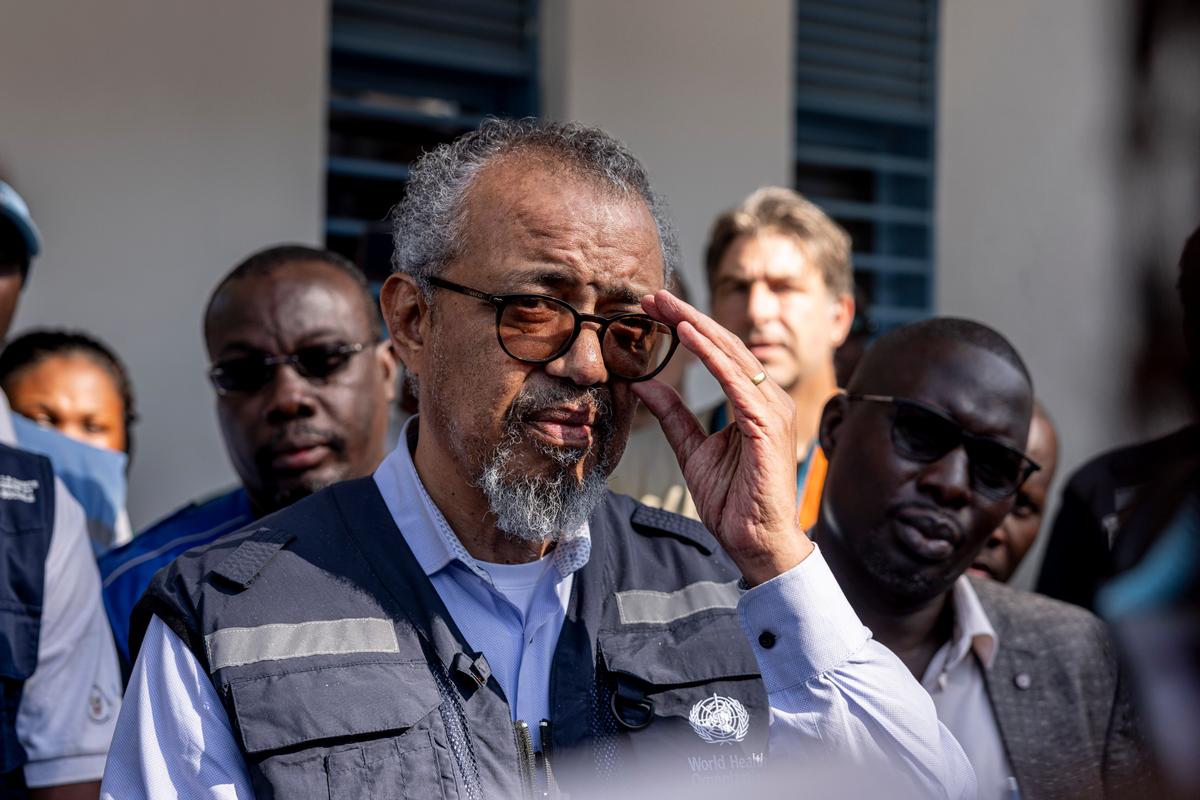
World Health Organization (WHO) Director-General Tedros Adhanom Ghebreyesus in Bunia, Congo, on May 31, 2026. Michel Lunanga/Getty Images
World Health Organization Director-General Tedros Adhanom Ghebreyesus said on Oct. 25 that a nurse responding to an Ebola alert in Bafwasende, Tshopo Province, was killed and another health worker seriously injured in an attack.
“Everyone working to protect communities from this deadly disease must be able to work in dignity and safety,” he said.
Julien Harneis, the U.N.’s senior Ebola coordinator, condemned the attack, calling it “a loss to the Ebola response and an even greater loss to patients and people in areas affected by Ebola.”
According to the U.N. refugee agency, Congo has more than 6.1 million internally displaced people, while continued violence in the east has restricted humanitarian access and complicated the delivery of healthcare.








 English (US) ·
 Turkish (TR) ·
