
China’s prolonged property downturn and mounting local government debt are squeezing construction projects, straining state-backed financing companies, and fueling a wave of job losses across the engineering and design industries.
Local governments, which
reliedheavily on land sales to fund spending, are facing dwindling revenue as home sales and property investment continue to fall. Additionally, authorities are winding down local government financing vehicles (LGFVs), which have funded infrastructure development for nearly three decades, leaving questions about how accumulated debts will be repaid.
China’s National Bureau of Statistics reported that property development investment fell 20.6 percent year over year in the first nine months of 2026 to 5.34 trillion yuan ($801 billion). Residential investment dropped 20.5 percent, while new home sales by floor area declined 13.2 percent. Land sale revenue also fell 27.9 percent in the first three quarters, according to data from the Ministry of Finance.
Local Debt Remains a Major Burden
China’s Ministry of Finance also reported that local government debt outstanding reached 59.9 trillion yuan ($8.98 trillion) as of the end of August. That figure excludes substantial hidden liabilities and business debts local government financing companies have accumulated.
Beijing has
introduceddebt relief measures, including refinancing and extending repayment periods, but these steps have largely eased interest costs as opposed to aiding with the underlying principal.
Estimates of the broader debt burden vary. The Ministry of Finance said local governments’ outstanding hidden debt had fallen to 6.5 trillion yuan ($974 billion) by the end of 2025. However, the International Monetary Fund (IMF) estimated that the LGFVs’ broader debt had reached 71.4 trillion yuan ($10.7 trillion) in the same period.
In August 2025, the Chinese regime ordered all local government financing platforms to exit their traditional financing roles or complete their transformation by the end of June 2027. The policy marks a retreat from a model in which local governments used state-backed companies to borrow money for infrastructure projects.
The companies may disappear or change their business models, but their debts will remain. Local governments, financial institutions, and other creditors could all face pressure as the financing system contracts.
U.S.-based Chinese current affairs commentator Li Linyi told The Epoch Times that China’s economic crisis has reached a point where it is beyond repair, arguing that the regime is merely postponing a broader local debt crisis.
Projects Halted as Financing Tightens
Several China-based individuals spoke to The Epoch Times on condition of anonymity out of fear of reprisal.
A project manager at a district-level financing company in Wuxi, Jiangsu Province, said that infrastructure investment has been cut sharply as the regime seeks to contain new borrowing.
“Since last year, some companies have been winding down projects. This year, the cuts have been across the board,” he said. “Government and state-owned enterprise projects are being stopped wherever possible.”
The manager said this would leave the construction sector with fewer opportunities, even as companies try to avoid layoffs.
A 28-year-old employee at the state-owned Kunming Survey and Design Institute of China Power Construction Group said he had previously left the state-owned enterprise (SOE) to work for a local financing company in Chuxiong, Yunnan Province.
He said he resigned after more than six months because of poor salary, and returned to the SOE.
The SOE employee said local financing companies were struggling because municipal governments were diverting funds to cover other obligations.
“A company is set up and then borrows from banks. Put simply, it obtains project funding for the government,” he said. “Once a project is awarded and the money reaches the company, the municipal finance bureau transfers it away directly to cover other debts.”
As a result, he said, some subsidiaries could no longer afford to pay employees.
These claims cannot be independently verified by The Epoch Times.
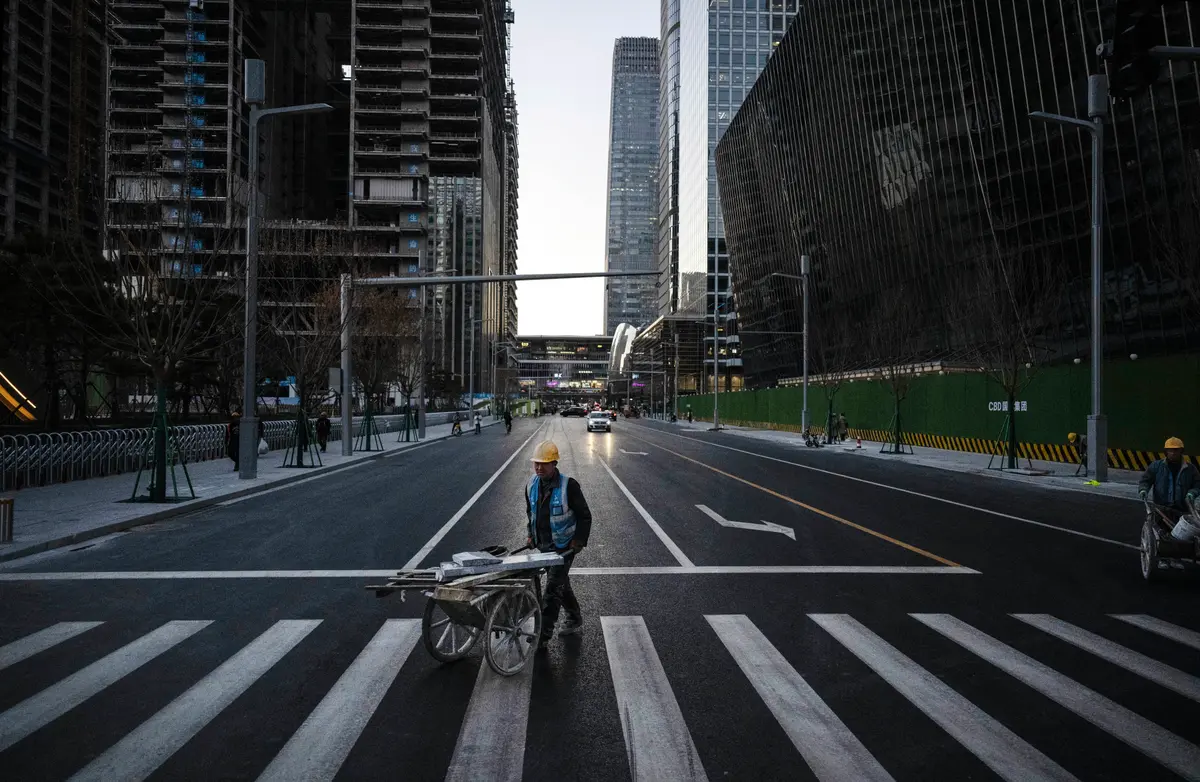
A construction worker pushes a wheelbarrow with materials across the road in the central business district in Beijing, China, on Nov. 29, 2024. Kevin Frayer/Getty Images
Engineering and Design Workers Lose Jobs
The contraction is spreading through industries that depend on government infrastructure spending. Construction contractors, building-material suppliers, engineering firms, and design institutes are all vulnerable as projects dry up and payments are delayed.
China’s Ministry of Housing and Urban-Rural Development reported that the number of design professionals employed by engineering survey and design companies fell from 1.019 million at the end of 2024 to 954,000 at the end of 2025, a decline of 65,000 in one year.
Workers interviewed by The Epoch Times described layoffs, unpaid wages, and declining salaries—even at SOEs.
A former civil engineer in Binzhou, Shaanxi Province, surnamed Zhao, told the publication that he lost his job in June after working on several projects, including one for the municipal government.
“There’s no work in the construction industry anymore, so they just send us home without paying us,” he said. “We take government contracts, but the government doesn’t settle the bills. That means wages aren’t paid, and project payments aren’t settled. In plain terms, the government is short of money.”
A master’s degree graduate who works at a construction design institute in Jincheng, Shanxi Province, told The Epoch Times that she earned just 2,650 yuan ($397) each month despite passing the institute’s written and interview examinations. The institute employs about 600 people, most of whom earn little more than 2,000 yuan ($300) monthly.
“Construction and civil engineering have declined,” she said. “The property market has declined, the population is shrinking, and local governments are in debt.”
She added that her institute depended on government contracts but often struggled to receive payment.
For workers who entered the industry expecting stable employment at state-backed institutions, the downturn has brought falling wages and growing uncertainty. With property investment contracting and local governments cutting infrastructure spending to manage debt, the traditional engine of China’s construction sector employment is weakening.
Tang Bing and Gu Xiaohua contributed to this report.









 English (US) ·
 Turkish (TR) ·
