

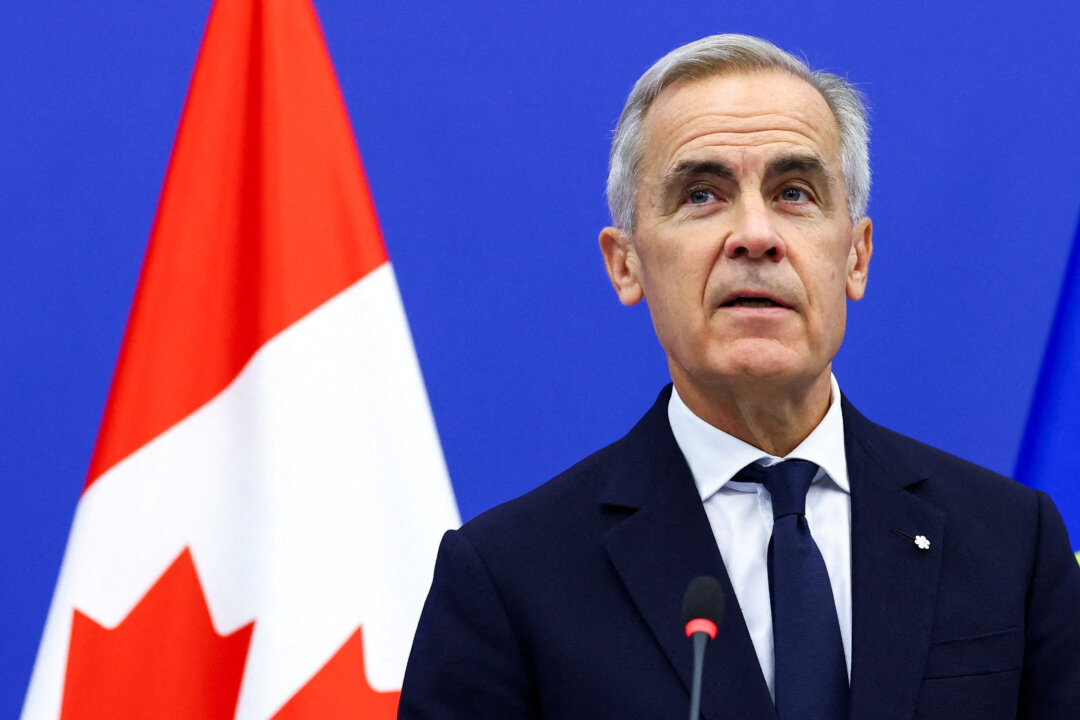
Prime Minister Mark Carney holds a joint press conference with European Parliament President Roberta Metsola (not pictured) after his address at the European Parliament in Strasbourg, France, on Sept. 17, 2026. Yves Herman/Reuters
Prime Minister Mark Carney says he had prior knowledge of certain details about Stellantis’ agreement to sell its Brampton, Ont., assembly plant before the deal was announced.
The factory was being retooled for Jeep production in early 2024, but the company paused the plan last year amid U.S. tariffs, and later announced it would move production of the Jeep Compass to Illinois. Stellantis then announced on Nov. 9 that it signed an agreement to sell its plant and associated equipment to Canadian armoured vehicle maker Roshel for an undisclosed amount.
Carney said the deal is a “partial solution” for the workers of the facility.
“Being informed—or being aware of some aspects—is not the same as Stellantis providing a global solution for those workers at the plant, which is their obligation,” Carney told reporters at a European Political Community meeting in Ireland on Nov. 12.
The prime minister described the sale as a “betrayal” of its workers, adding that the company had a responsibility to take care of them.
“That’s the responsibility they made multiple times, including in the battery deal that they signed with the government,” Carney said. “We will pursue all of this. A partial solution is a step it is not a global solution. That is a betrayal.”
He also said the company has failed to honour several agreements signed with the provincial and federal governments.
Ottawa and Ontario jointly committed $15 billion in support to Stellantis and LG Energy Solution in 2023 for a manufacturing investment in Windsor, Ont., but Stellantis announced in February it would sell its 49 percent stake to LG Energy.
Stellantis said in a statement on
Nov. 10 thatit was willing to pay back federal funds it received to retool the Brampton auto plant, given that Canadian taxpayers “expect accountability for public funding.” It also noted that it did not receive the $15 billion originally earmarked for battery-production incentives at the NextStar Energy plant in Windsor.
Carney was also asked about the potential for Chinese car manufacturing being brought to Canada. He said Ottawa wants “real opportunities” for Canadian auto workers, particularly with European, Japanese, and Korean partners.
“The extent to which there’s Chinese investment depends on a variety of factors,” Carney said. “It'll be one of the discussions with [Chinese] President Xi. Of course, it also is relevant to our ongoing discussions with the United States.”
Ontario Premier Doug Ford had warned Stellantis
on Nov. 9 againstbringing production solutions from China to its idled factory, saying it would “bastardize the whole sector.”
Conservative Leader Pierre Poilievre has been critical of Ottawa’s handling of the Stellantis file, and he called for the resignation of Industry Minister Mélanie Joly on Nov. 10 while speaking to reporters. Poilievre also accused Joly of not doing enough to protect Canadian auto-sector jobs, and failing to follow through on threats of legal action against companies moving production to the United States.
Carney defended Joly during a Nov. 10 press conference later that day, saying the issue was not the “exceptional work of the minister of industry,” but the “behaviour of the company versus of those workers.”
Jennifer Cowan contributed to this report.



 English (US) ·
 Turkish (TR) ·
