
Brent crude oil futures hit a high of almost $110 per barrel on Friday for the first time since May amid ongoing tensions in the Middle East and concerns about Russian supplies.
Oil futures closed at around $109.69 per barrel on Friday, up by more than 3.5 percent from Thursday’s closing price. Prices have risen by over 50 percent since the end of Feb. 27, a day before the U.S.–Iran war broke out.
In an Oct. 16 post at ING Bank, authors Warren Patterson, head of commodities strategy, and Ewa Manthey, commodities strategist, said that oil prices were holding firm “as Middle East tensions refuse to cool.”
“Uncertainty in the Middle East and concerns over the sustainability of oil flows through the Strait of Hormuz has the market pricing in a significant risk premium,” the authors wrote. “In order to see a full removal, there needs to be some kind of agreement between the U.S. and Iran.”
Before Friday’s oil spike, President Donald Trump
saidThursday that the U.S. military was considering using the GBU-43/B Massive Ordnance Air Blast, also known as the “Mother of All Bombs,” against Iran. Earlier on Oct. 8, Trump had said that the United States would not conduct new strikes against Iran before the midterm elections on Nov. 3.
In a recent interview with Iranian state-run Press TV, Mohsen Rezaei, secretary of Iran’s Supreme National Security Council, said that Tehran could
targetU.S.-linked tech infrastructure worth over $2 trillion if Washington attacks the country. Such infrastructure includes cables, artificial intelligence facilities, data centers, and other sites in the Middle East, Rezaei said.
In Saudi Arabia, state-owned Saudi Aramco came under
attackon Oct. 13. Authorities did not say who was behind the attack. Saudi Arabia’s conflict with Yemen’s Iran-backed Houthi terrorists has been intensifying over the past few weeks.
Around 25 percent of global seaborne oil trade typically flows through the Strait of Hormuz. This was initially
disruptedafter the U.S.-Iran war began in late February.
On Oct. 13, three container ships were struck in the Strait of Hormuz, with one sinking. Earlier, on Oct. 11, five ships were damaged, four in the Strait of Hormuz and one off the coast of Oman. Four of the vessels were oil tankers, while one was a container ship. Two of the oil tankers were sailing under the flag of Liberia, with the other two under the Panama and Bahamas flags. The container ship was operating under the flag of India.
Russia was the second-largest producer of crude oil and certain hydrocarbons in 2025, and recent developments in the Russia-Ukraine war are contributing to economic uncertainty and heightened fuel prices.
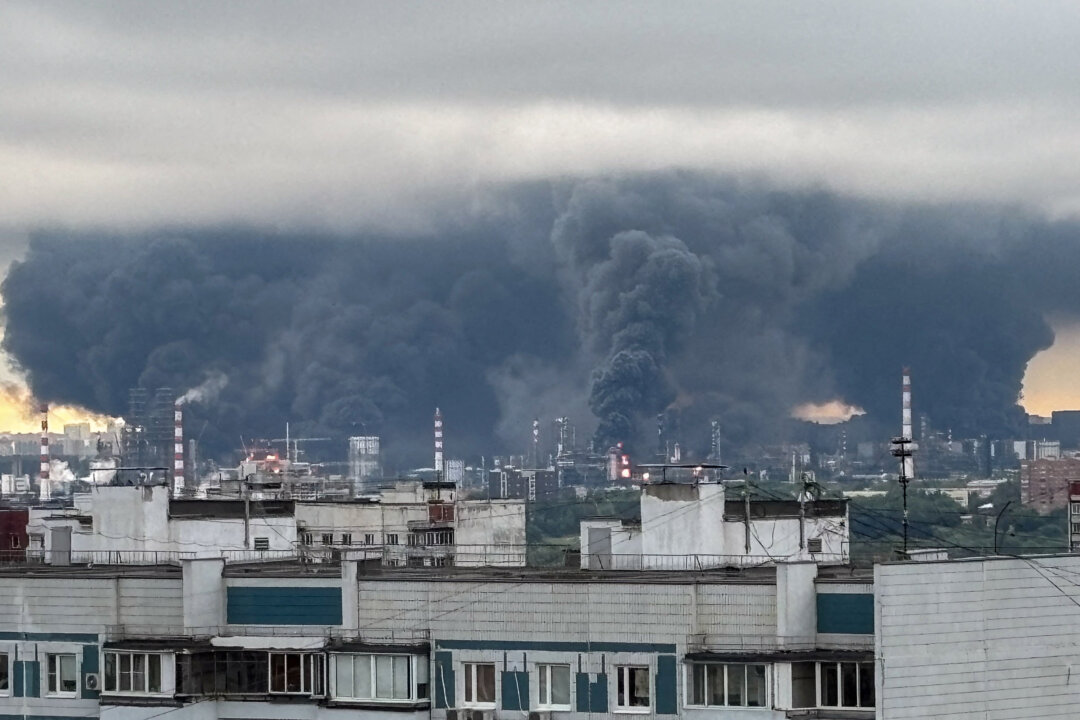
Ukraine had halted attacks on Russian oil refineries after Trump announced an energy ceasefire between Moscow and Kyiv on Oct. 11. However, during the night of Oct. 14 and the morning of Oct. 15, Ukraine struck the Ryazan region of Russia, which led to a fire at an oil refinery, according to Ryazan Gov. Pavel Malkov.
US Gas Prices
Elevated crude oil prices are contributing to high U.S. gasoline prices. On Oct. 17, the average national price of a gallon of regular gasoline was $4.30, up from $3.05 a year back, based on American Automobile Association data.
Diesel prices have jumped from a low of $3.45 per gallon in January to $6.17 as of Oct. 12, according to data from the Federal Reserve Bank of St. Louis.
Meanwhile, the Trump administration has taken action to ease the upward pressure on diesel and gasoline prices.
On Oct. 9, Trump
announceda U.S.–Russia deal that would allow Moscow to supply diesel to the international market, including the United States, in exchange for lifting certain sanctions on Russia.
On Sept. 29, the United States
offeredto lend energy companies up to 40 million barrels of oil from its Strategic Petroleum Reserve.
And in an Oct. 10 statement, the Department of Energy
saidit was authorizing an emergency release of up to four million barrels of crude oil from the emergency reserve. This was done to mitigate a supply disruption caused by Hurricane Isaias.
“With this emergency exchange, the Energy Department is acting swiftly to help maintain refinery operations, limit disruptions to fuel supplies, and ensure American families and businesses continue to have access to affordable, reliable, and secure energy,” Secretary of Energy Chris Wright said in the statement.








 English (US) ·
  Turkish (TR) ·