
Chinese state media has recently aired a documentary on cracking down on telecom fraud in northern Burma, while international investigations and an insider indicate that Chinese national security is behind some of the cyber scam syndicates in Southeast Asia.
Chinese state broadcaster CCTV has been airing a documentary from Oct. 5 to 7, co-produced with the Chinese regime’s Ministry of Public Security, revealing details about some of the cyber scam compounds.
In recent years, global cyber scams have been traced to compounds in northern Burma and Cambodia linked to China that also engaged in human trafficking, forced labor, and other crimes. In January, the Chinese regime executed 11 criminals who had been found guilty of having established multiple operational bases in Burma to engage in telecom fraud, operate illegal gambling dens, and commit other crimes in operations dating back to 2015.
In the documentary, a man surnamed Tang—who had been trafficked into a scam compound in the Wa state in northern Burma, also known as Myanmar, in 2021 and was referred to as a “piglet” (a term for trafficking victims used by syndicates)—recounted how he was forced into telecom fraud operations by his captors. Due to poor “performance,” he was forced to sign an agreement to pay for 70,000 yuan (about $10,441) of “debt.” Subsequently, he was resold among various syndicates in the area and subjected to beatings.
Tang said in the documentary that he was beaten repeatedly and eventually his wounds became infected and he could no longer walk. The scam syndicate then offered to harvest his kidney to clear his debt. Tang said that in his desperation, he agreed to it: “I would have been willing to have a leg or an arm sawed off—let alone a kidney—just to get out of there,” he said. Tang said he was eventually taken to a farmhouse courtyard where one of his kidneys was surgically removed after a matching recipient was found.
The Chinese regime’s forced organ harvesting in China has spilled over from Falun Gong practitioners to other members of the Chinese public, with frequent reports on social media of young people missing and organs being taken.
The U.S. Senate passed the Falun Gong and Victims of Forced Organ Harvesting Protection Act (S.4009) on Sept.28. The bill aims to address the Chinese regime’s persecution and forced removal of organs from prisoners of conscience, largely Falun Gong practitioners, Uyghurs, and other religious or ethnic minority groups.
Chinese state media said that the documentary shows the efforts of Chinese public security agencies, in collaboration with relevant departments, to combat China-related crimes in northern Burma, and claimed that criminal syndicates such as the “four major Families” of northern Burma have been “completely eradicated.”
Chinese National Security Behind the Syndicates
After being arrested in Thailand in 2022, She Zhijiang—founder of the Asia-Pacific New City (also known as Yatai New City) in Myawaddy, Burma, another cyber scam syndicate—stated in an interview with international media while in prison that he had been recruited as an intelligence operative by personnel from the Chinese Ministry of State Security in the Philippines in late 2016.
A 2025 report by the U.S. Congressional-Executive Commission on China (CECC) notes that the Asia-Pacific New City project previously received support from Chinese Communist Party (CCP) officials and Chinese-funded enterprises, and later became a major epicenter for transnational crime, human trafficking, and cyber scams in Southeast Asia.
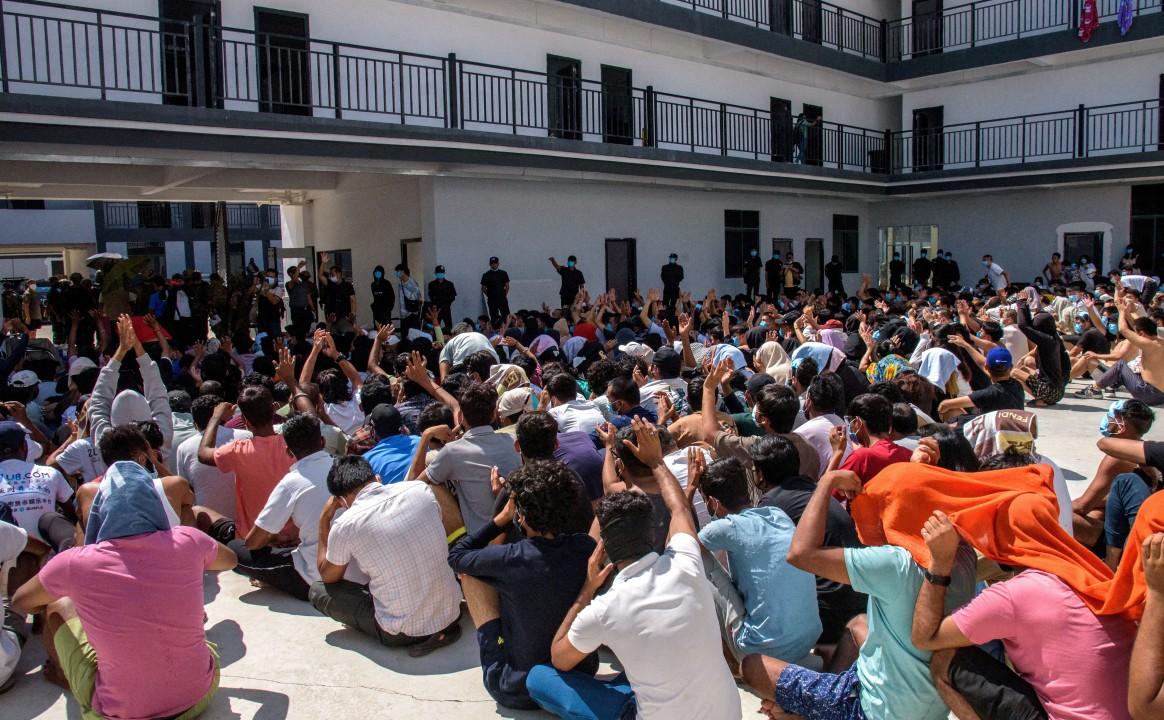
Scam center workers, many of whom were trafficked and forced to work for criminals, are guarded by Karen Border Guard troops in Myawaddy, Burma, on Feb. 26, 2025. STR/Reuters
Cambodia is another major hub for Southeast Asian cyber scam compounds. Chen Zhi, founder of Cambodia’s Prince Group, was extradited to China from Cambodia in early 2026 for cyber scams. Between 2021 and 2022, the Prince Group won the Model of Social Responsibility Award at the China Finance Summit for two consecutive years, and had previously been featured by Chinese state-run media outlets.
A U.S. Department of Justice document shows that Chen was implicated, sanctioned, and indicted for his role in operating massive transnational scam and human trafficking compounds.
Chen and senior executives of the Prince Group leveraged political influence to shield fraudulent activities and maintained connections with China’s Ministry of Public Security and Ministry of State Security, according to the document. The U.S. Department of Justice in the document stated that Prince Group executives provided benefits to officials in exchange for advance information regarding law enforcement raids; it also notes that Chen disclosed to others his cooperation with the Chinese Ministry of State Security to obtain intelligence on law enforcement operations.
A former Chinese spy, who defected to Australia and used the alias “Eric,” told The Epoch Times that Chen’s Prince Group is a key proxy for the CCP’s covert operations in Cambodia and across Southeast Asia, serving as an overseas financial and logistical hub for the CCP’s intelligence network.
Eric revealed that he had witnessed officials from the CCP’s public security apparatus—traveling from Beijing and Chongqing—holding meetings at Chen’s private club in Cambodia, Yunxuan Pavilion, to plot the kidnapping of exiled cartoonist “Biantai Lajiao” whose real name is Wang Liming. The Prince Group handled all hosting arrangements for the operation, Eric said. The plot failed.
Zhao Bin contributed to this report.







 English (US) ·
  Turkish (TR) ·